
When choosing an NAD+ research pen, the pen format is only one part of the decision. For laboratory procurement, check whether the product is clearly limited to research, whether its supporting documents identify the tested lot, and whether the stated handling requirements fit your workflow.
A pre-filled format can simplify procurement, but it doesn’t replace evidence or clear product information. This guide explains how to assess format, lot-specific testing, shipping, and storage so qualified scientific personnel can make a more informed choice for in-vitro laboratory research.
We’ll cover what HPLC purity and aqueous pH certificates tell you, why lot-level documentation is useful without promising experimental results, and which handling details matter. ReadyPep distributes NAD+ 1000mg pens synthesized, cartridge-filled, and nitrogen-sealed by Metatide Healthcare. The pens are solely for in-vitro laboratory research by qualified scientific personnel, not for human or veterinary use. Before selecting a product, consider its stated refrigeration, light-protection, and no-freezing requirements.
Key Takeaways
- Check whether an NAD+ research pen’s pre-filled format and stated research-use scope fit your laboratory’s procurement requirements.
- Review lot-specific HPLC purity and aqueous pH certificates as records of the tested lot, not guarantees of research outcomes.
- Plan receipt and handling around the product’s published storage limits: refrigerate at 2-8 °C, protect from direct light, follow the stability window after opening, and do not freeze.
- Compare product information by format, lot documentation, storage guidance, and clearly stated in-vitro research scope.
- Use these checks to evaluate the NAD+ 1000mg pen without treating research-use documentation as evidence of suitability for human or veterinary use.
What an NAD+ research pen is and what research-only means
An NAD+ research pen is a pre-filled, multi-dose format intended for laboratory research. ReadyPep’s pen is for in-vitro research by qualified scientific personnel only, not human or veterinary use. That boundary is central to understanding the product. The pen format describes how the material is supplied, not whether it is suitable for a particular experiment or any use outside the stated research context.
What does NAD+ refer to in a research context?
NAD+ stands for nicotinamide adenine dinucleotide. Nicotinamide adenine dinucleotide (NAD+) is a coenzyme central to metabolism. In laboratory research, the term identifies the compound being studied. It does not, by itself, describe a health benefit or predict an experimental result.
This distinction matters because consumer-facing descriptions may associate NAD+ with wellness, treatment, energy, or performance. Those claims are not a definition of laboratory research. Discuss a research-only product in terms of its stated scientific scope and available product information, without turning that description into a human-use recommendation. A label also doesn’t establish suitability for a research question. That assessment belongs within the qualified laboratory’s research and procurement process.
What does pre-filled pen format mean for procurement?
A pre-filled, multi-dose pen is supplied in pen format rather than as a separately supplied vial. Record the format alongside the compound identity and research-use scope in your procurement review. The format doesn’t establish suitability for a particular experiment, and it doesn’t replace review of the relevant documentation and handling information.
ReadyPep distributes a pre-filled NAD+ 1000mg research pen for in-vitro laboratory research. Metatide Healthcare synthesizes, cartridge-fills, and nitrogen-seals the pens. This identifies the product and the organizations involved without implying that ReadyPep manufactures it or that the format carries therapeutic approval. The NAD+ 1000mg product details provide qualified research personnel with a product-specific reference for reviewing the offering.
Keep the scope clear: this pen is not for wellness, treatment, performance enhancement, or human or veterinary use. It is for in-vitro laboratory research by qualified scientific personnel. A pre-filled format may simplify procurement, but convenience is not proof of research suitability. Evaluate the lot-specific evidence and handling requirements separately, without treating either as a promise of results.
How to evaluate NAD+ pen documentation without overreading a certificate
A certificate records information about a tested lot; it doesn’t promise a particular research result. It can document specific measured properties, but it doesn’t establish how material will perform in every laboratory setting or answer every quality question. Read it as one procurement record and keep its meaning within the test’s stated scope.
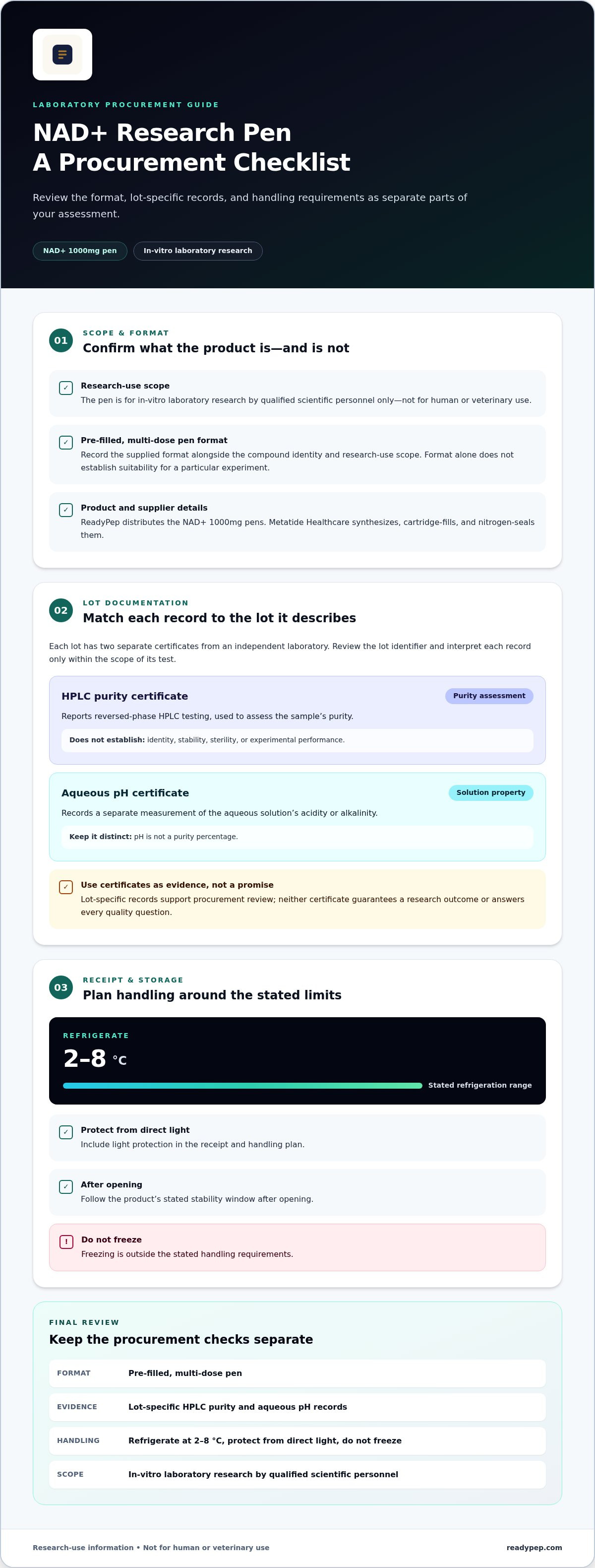
For ReadyPep NAD+ 1000mg pens, each lot has two separate certificates from an independent laboratory: one for HPLC purity and one for aqueous pH. The purity document reports reversed-phase HPLC testing. The pH document reports a measurement of the aqueous solution’s acidity or alkalinity. These are different measurements: purity testing assesses the composition profile, while pH testing measures a solution property.
What does an HPLC purity certificate tell a researcher?
Reversed-phase high-performance liquid chromatography separates components in a sample as they pass through a column under specified conditions. The analysis is used to assess the sample’s purity. Review the certificate for the lot it applies to and the result it reports. Don’t treat purity alone as proof of identity, stability, sterility, or experimental performance. Those are separate questions the certificate does not answer.
Why is aqueous pH documented separately?
pH is a measured property of the aqueous solution, not a purity percentage. A separate pH certificate provides a distinct piece of lot-level information alongside the HPLC purity document. For a broader overview of laboratory testing and quality control, remember that different test types answer different questions. The wider scientific context also continues to evolve, as discussed in this review of NAD+ research.
For practical document review, tie the evidence to the product lot rather than relying on a general testing claim. Check what was tested and which property the certificate addresses. If a certificate displays a lot identifier, compare it with the lot information associated with the product. Keep the two test records distinct:
- HPLC purity certificate: records the independent laboratory’s reversed-phase HPLC assessment of purity.
- Aqueous pH certificate: records a separate pH measurement for the aqueous solution.
Neither result guarantees a research outcome. The value is having lot-specific evidence to review during procurement, with each test interpreted only within its stated scope. Qualified research personnel can review the available research product information alongside these records as part of that assessment.
Compare NAD+ research pens by format, evidence, and product transparency
A useful comparison separates what a product is from what its documentation supports. Format describes how it is supplied. Lot records document specific measurements. Storage information guides handling. Stated research-use scope clarifies the product’s intended context. These are more useful procurement details than broad claims that don’t identify what was measured or which lot the evidence applies to.
Which comparison criteria matter for laboratory procurement?
Compare product identity, format, lot-level documentation, handling instructions, and research-use limits. Keep the categories separate: a pre-filled pen describes presentation, while test records describe measured properties. Neither alone establishes suitability for a particular experiment.
| Criterion | ReadyPep NAD+ 1000mg pen | How to use the comparison |
|---|---|---|
| Format and product identity | Pre-filled, multi-dose pen; listed as NAD+ 1000mg | Record the stated compound, amount, and format. Don’t infer experimental suitability from the pen design. |
| Lot documentation | Each lot has separate independent HPLC purity and aqueous pH certificates | Note which property each document measures and whether its lot identification corresponds to the product being assessed. |
| Storage information | Refrigerate at 2-8 °C, protect from direct light, follow the product-page stability window after opening, and do not freeze. | Compare stated handling limits with your receiving and storage arrangements. Don’t assume unstated conditions. |
| Research-use scope | Solely for in-vitro laboratory research by qualified scientific personnel, not human or veterinary use | Look for a plain statement of scope. Don’t interpret research-use wording as a human-use claim. |
How does ReadyPep present its NAD+ 1000mg pen?
ReadyPep is an authorized distributor, not the manufacturer. Metatide Healthcare synthesizes, cartridge-fills, and nitrogen-seals the pen. This makes the supply relationship clear and keeps the product description tied to stated details rather than assumptions about its origin or performance.
In any product comparison, distinguish documented facts from claims that require separate evidence. A stated format, lot certificate, storage limit, or research-use boundary is a concrete detail to record. A promise of experimental results, or an inference about qualities the listed tests don’t measure, is not established by those details. Apply the same standard to each product: don’t fill gaps in unstated specifications with guesses or treat them as a comparison advantage.
Qualified research personnel can compare the NAD+ 1000mg pen details with their laboratory’s procurement requirements. This keeps the review grounded in product identity, lot evidence, format, handling, and scope, without turning documentation into a guarantee.
Plan NAD+ pen receipt and storage around the stated handling limits
Storage planning starts before a shipment arrives. Make sure your receiving workflow can move the pen into the specified conditions without relying on assumptions about how long it can remain elsewhere. ReadyPep offers free express worldwide shipping with cold-chain shipping. These are shipping details, not promises about customs clearance or other border outcomes.
What should a researcher do when the shipment arrives?
Plan for receipt so the pen can be refrigerated promptly. The stated storage range is 2-8 °C, away from direct light. Maintain those conditions after arrival, and don’t treat cold-chain shipping as a substitute for storage instructions at the destination.
- Arrange refrigerator space that maintains the stated 2-8 °C range.
- When the shipment arrives, place the pen in refrigerated storage, away from direct light.
- Keep the product refrigerated and protected from direct light while following the product-page guidance.
- Do not freeze.
This sequence stays within the stated handling limits. It doesn’t assume a temperature-monitoring feature, special arrival inspection, or a storage allowance outside the specified range. For procurement planning, have appropriate storage ready and avoid introducing unverified handling steps.
How should an opened pen be stored?
Opening the pen doesn’t remove the storage requirements. Continue refrigeration at 2-8 °C and protect it from direct light. Do not freeze. After opening, follow the stability window stated on the product page instead of applying a general duration or assuming the unopened guidance defines the opened period.
Keep the product-specific window accessible to the personnel responsible for storage. A general rule of thumb cannot replace the stated stability guidance, and no duration should be inferred where the product page provides the relevant limit. This keeps handling decisions tied to the product information rather than assumptions.
Shipping and storage answer different questions. Cold-chain shipping describes the shipping arrangement; the 2-8 °C range, light protection, no-freezing instruction, and after-opening stability window guide storage. None of these details guarantees a particular research result. They help qualified scientific personnel plan receipt and handling within the product’s stated limits.
ReadyPep distributes the pre-filled NAD+ 1000mg research pen for in-vitro laboratory research by qualified scientific personnel only, not human or veterinary use. Review the NAD+ 1000mg product details for its stability window after opening and other handling information. If the format and stated requirements fit your procurement review, explore ReadyPep’s research product information.
Choose a documented NAD+ research pen and review the product details
A sound procurement review brings four questions together: Is the product explicitly limited to in-vitro laboratory research? Is lot-specific documentation available? Is the pre-filled format clearly described? Are the storage requirements practical for your receiving and laboratory setup? These checks clarify the product information without turning certificates or format into promises of experimental performance.
ReadyPep’s NAD+ 1000mg pen is solely for in-vitro laboratory research by qualified scientific personnel, not human or veterinary use. ReadyPep distributes the pen, which Metatide Healthcare synthesizes, cartridge-fills, and nitrogen-seals. ReadyPep does not provide medical advice or protocol design. Research personnel remain responsible for determining whether a product fits their procurement criteria, without treating its description as a recommendation for a particular study.
What to review on the NAD+ product page
Use the NAD+ 1000mg product details to review the current product specifications, stated research-use scope, and handling information. The product page also provides access to lot certificates. Compare the lot identifiers and read each document for the property it reports: HPLC purity or aqueous pH. These records support a more specific procurement review, but they don’t guarantee experimental outcomes or establish qualities beyond what was tested.
Before proceeding, make sure the product format and stated storage conditions fit your laboratory’s requirements. Refrigerate the pen at 2-8 °C, keep it away from direct light, and do not freeze it. After opening, follow the stability window on the product page. Keep these handling limits distinct from the lot certificates: the storage details guide handling, while the certificates report separate test results.
What happens after submitting an order?
Order confirmation and payment follow order submission through a secure link. On-site card checkout isn’t available. This payment detail is separate from product documentation, intended use, and handling requirements.
In short, assess the stated research-only scope, inspect the available lot certificates, consider the pre-filled format, and plan for the published handling limits. Each provides a different part of the procurement picture. None should be read as a guarantee of performance or evidence of suitability for a particular protocol.
For qualified scientific personnel whose procurement review aligns with these details, review ReadyPep’s research product information.
Make your next review evidence-led
Choosing an NAD+ research pen calls for disciplined evaluation, not a shortcut to a particular result. Use the available information to create a procurement record your team can interpret consistently: distinguish what the documents establish from what requires separate scientific assessment, and consider whether the stated product details fit your laboratory’s requirements.
This approach keeps the decision grounded in verifiable information. It also prevents a product format or a single test result from carrying more meaning than it can support. The next step is a focused review of the product information and its associated lot records, applying your research team’s own criteria.
Review the NAD+ research pen and its lot documentation as you complete that evaluation. A clear, evidence-led process gives qualified research personnel a practical basis for informed procurement decisions. Proceed using the information you can verify.
Frequently Asked Questions
What is NAD+ in a research pen?
NAD+ is nicotinamide adenine dinucleotide, the compound supplied in the pen for in-vitro laboratory research. The ReadyPep NAD+ research pen is a pre-filled, multi-dose format, listed as NAD+ 1000mg. Its identity and format describe what is supplied; they don’t indicate a health benefit or determine whether it fits a particular experiment. Qualified scientific personnel should assess it against their laboratory’s research and procurement requirements.
Are NAD+ research pens approved for human use?
No. ReadyPep’s NAD+ pen is intended solely for in-vitro laboratory research by qualified scientific personnel, not human or veterinary use. Its research-use designation should not be interpreted as therapeutic approval, a wellness product claim, or permission to use it on people or animals. ReadyPep doesn’t provide medical advice or protocol design. Keep the product within its stated laboratory scope and don’t treat research documentation as evidence of human-use safety.
What does an HPLC certificate show for a research peptide pen?
An HPLC certificate records a purity assessment for the tested lot using reversed-phase chromatography. ReadyPep’s stated purity expectation is at least 99%. That result addresses purity as measured by the test; on its own, it doesn’t establish identity, sterility, stability, or performance in an experiment. For procurement records, note the lot identifier and specific result, then interpret them only within the certificate’s stated testing scope.
Can I download the NAD+ pen's lot certificates?
Yes. The lot certificates are available from the NAD+ product page. There are separate documents for HPLC purity and aqueous pH, so save both with the associated procurement records rather than treating them as interchangeable. For traceability, retain copies alongside the product or lot information used by your laboratory. The certificates document a lot’s test results; they don’t guarantee a particular experimental outcome.
How should an NAD+ research pen be stored?
Refrigerate the pen at 2-8 °C and protect it from direct light. Do not freeze. After opening, continue refrigeration and follow the stability window stated on the product page instead of applying a general storage duration. For a laboratory handoff, make sure the person responsible for storage has access to these instructions and can maintain the stated conditions.
How is a ReadyPep NAD+ pen shipped internationally?
ReadyPep offers free express worldwide shipping with cold-chain shipping. This describes the shipping arrangement, not a guarantee about delivery timing, customs processing, or import outcomes. Researchers arranging international procurement should plan the destination’s receiving workflow and have refrigerated storage ready for the pen’s arrival. Use the product’s stated handling requirements when planning the transition from shipment to laboratory storage.
Can I pay for a peptide pen directly at checkout?
No. On-site card checkout isn’t available for peptide pens. After you submit an order, order confirmation and payment are handled through a secure link. Submitting an order and completing payment are separate steps. Review the product information and research-use scope before placing an order, and proceed only if the offering aligns with your qualified laboratory’s procurement requirements.
Disclaimer
Educational content only. Not medical advice.


