

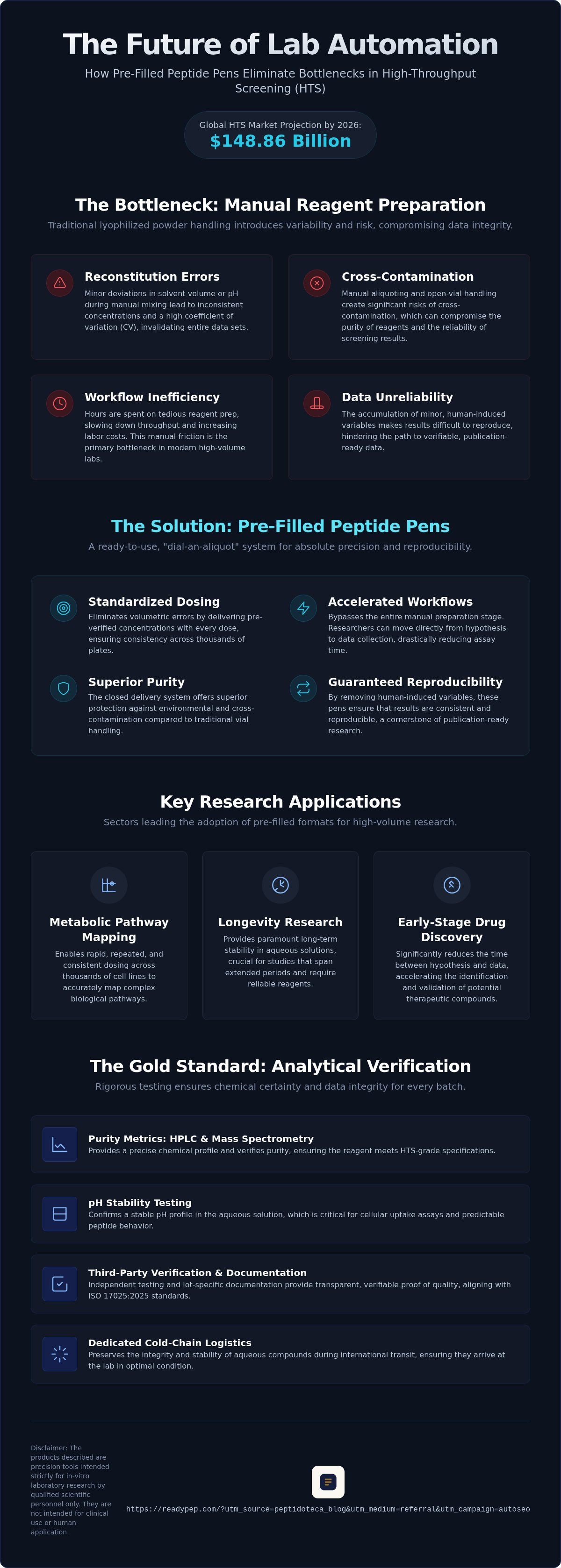
In high-throughput screening, the bottleneck isn't the assay itself. It's the variability of manual reagent preparation. You know the routine. Hours spent over lyophilized powders. The constant worry about reconstitution errors. One slight deviation in volume can compromise thousands of data points. It's a liability that modern laboratories can't afford, especially when using pre-filled peptide pens for high-throughput screening could eliminate the risk entirely. With the 2026 global HTS market projected to reach $148.86 billion, efficiency is mandatory. Precision is the only path forward.
We understand that data integrity is your primary currency. You've likely seen how manual aliquoting leads to inconsistent results and cross-contamination. This guide explores how pre-filled formats ensure standardized dosing and provide the verifiable purity required for publication-ready results. You'll discover how to accelerate your in-vitro workflows while reducing the labor costs associated with traditional reagent prep. We'll break down the technical advantages of these systems and how they integrate into high-volume, automated lab environments to guarantee reproducibility across every single plate.
Key Takeaways
- Discover how pre-filled peptide pens for high-throughput screening eliminate the variability inherent in manual reconstitution and lyophilized powder handling.
- Learn the specific analytical standards, including HPLC and pH testing, required to ensure reagent stability and purity in high-volume in-vitro studies.
- Understand why closed delivery systems offer superior protection against cross-contamination compared to traditional vial handling in a laboratory setting.
- Master the protocols for integrating multi-dose pens into semi-automated workflows to achieve standardized dosing across thousands of assay plates.
- Explore the critical role of dedicated cold-chain logistics in preserving the integrity of aqueous research compounds during international transit.
The Role of Pre-filled Peptide Pens in Modern High-Throughput Screening (HTS)
High-throughput screening is the engine of modern drug discovery. In 2026, the lab environment is moving away from the manual friction of powder reconstitution. Pre-filled peptide pens for high-throughput screening represent a fundamental shift in reagent management. These are ready-to-use, dial-an-aliquot delivery systems. They replace the traditional lyophilized vials that have slowed down laboratory throughput for decades. By transitioning to pre-filled aqueous formats, researchers can bypass the most error-prone stage of the assay process. This "frictionless" approach is now the baseline for high-volume research in metabolic pathways, longevity, and early-stage drug discovery.
Standardizing High-Throughput Screening (HTS) protocols requires absolute consistency across every micro-liter. When reagents are pre-stabilized, the focus shifts from preparation to results. Several key sectors are leading this adoption:
- Metabolic Pathway Mapping: Requiring rapid, repeated dosing across thousands of cell lines.
- Longevity Research: Where long-term stability in aqueous solution is paramount.
- Early-Stage Drug Discovery: Focusing on reducing the time between hypothesis and data.
Addressing the Reproducibility Crisis in Peptide Research
Manual reconstitution is a notorious source of volumetric error. Even the most precise technicians introduce variability when mixing lyophilized powders. These minor discrepancies compound when scaled across hundreds of 384-well plates. A slight deviation in solvent volume leads to a higher coefficient of variation (CV), which can invalidate entire data sets. Utilizing pre-filled peptide pens for high-throughput screening eliminates these human-induced variables.
Variable pH is another hidden threat to data integrity. In aqueous environments, pH stability is critical for cellular uptake assays. If the pH drifts during manual mixing, the peptide's behavior changes, making the resulting data unreliable. Pre-filled systems deliver a pre-verified concentration and pH profile every time. This level of standardization is essential for labs aiming for publication-ready data and verifiable results.
In-Vitro Research Compliance and Scope
These instruments are precision tools designed for qualified scientific personnel. Their application is strictly limited to in-vitro laboratory research. They are not for clinical use or human application. Maintaining this boundary is vital for laboratory compliance and safety standards.
Quality begins at the manufacturing level. The Metatide Healthcare manufacturing standard ensures that every pen meets rigorous purity requirements before it reaches the bench. Every lot undergoes independent testing to verify its chemical profile and stability. For laboratories that prioritize transparency and data integrity, sourcing pre-filled research peptides from authorized distributors is the most reliable way to ensure compliance with the 2026 digital traceability standards required by ISO 17025:2025.
Technical Specifications and Analytical Standards for HTS-Grade Peptides
High-throughput screening demands more than just volume. It requires chemical certainty. In 2026, relying on unverified reagents is a significant risk to project timelines. Every batch of pre-filled peptide pens for high-throughput screening must meet rigorous analytical benchmarks before entering the lab. This isn't just about quality control. It's about data integrity. Without precise specifications, the noise in your data will eventually drown out the signals you're looking for.
Independent verification is the gold standard for modern research. ReadyPep utilizes Janoshik Analytical for third-party testing on every lot. This provides researchers with transparent access to HPLC and pH data. Without lot-specific documentation, publication-ready results remain out of reach. Verifying these parameters ensures that your screening results are reproducible across thousands of iterations. It eliminates the "black box" nature of sourcing and replaces it with empirical proof.
Purity Metrics: HPLC and Mass Spectrometry
HPLC purity is the ratio of the target peptide to total impurities. In high-sensitivity screening, even trace impurities are problematic. These contaminants can interfere with ligand-receptor binding assays, leading to false positives or negatives. For HTS environments, a purity level of 99% or higher is the industry baseline. Mass spectrometry confirms the identity of the compound. HPLC ensures that what you're measuring is actually the peptide and not a synthetic byproduct that could skew your results.
The Critical Factor of pH in Aqueous Peptides
pH levels dictate peptide solubility and secondary structure. If the pH shifts outside of the optimal range, the peptide may aggregate or lose its biological activity. This is particularly dangerous in cell culture environments. An acidic or basic shift can stress the cells, introducing noise into your assay data. ReadyPep ensures stability through precise pH verification for every aqueous solution. By maintaining a neutral, pre-verified range, these pens prevent the unexpected shifts that often occur during manual reconstitution.
Standardizing your reagents is the first step toward reducing laboratory noise. For researchers who value empirical proof over marketing claims, reviewing the latest Janoshik test results offers the transparency needed for high-stakes screening. Utilizing pre-filled peptide pens for high-throughput screening means you spend less time troubleshooting reagent quality and more time analyzing your data.
Comparing Pre-filled Pens vs. Manual Lyophilized Reconstitution
Manual reconstitution is an expensive use of a researcher's time. In high-throughput environments, every minute spent over a vial is a minute lost to analysis. Traditional lyophilized powders require precise solvent addition, gentle agitation, and careful aliquoting. This process is inherently variable. Pre-filled peptide pens for high-throughput screening eliminate these steps entirely. They arrive pre-stabilized and ready for immediate use. By removing the preparation phase, labs can significantly increase their daily assay capacity without adding staff.
Contamination risk is a primary concern during vial opening. When you uncap a lyophilized vial, you expose the powder to airborne particulates and potential cross-contamination. Closed pen systems maintain a sterile environment from the first dose to the last. This is critical for 2026 laboratory standards. Volumetric precision also suffers in manual setups. Syringe graduations are prone to parallax error and human misinterpretation. In contrast, pre-filled pens utilize 0.01ml click-dosing. This mechanical precision ensures that every aliquot is identical. It's the difference between "close enough" and "mathematically certain."
Aqueous stability is another factor. ReadyPep’s pre-mixed solutions are formulated to maintain integrity in multi-dose formats, ensuring that the last click is as potent as the first. This eliminates the degradation concerns often associated with "home-brewed" aliquots stored in standard lab freezers. When reagents are standardized at the source, the shelf-life becomes a predictable metric rather than a guessing game.
Workflow Efficiency: A Comparative Analysis
Consider the labor involved in a 384-well plate setup. Manual preparation for a single plate can take upwards of thirty minutes. When scaled across dozens of plates, the time-cost becomes staggering. Pre-filled formats offer a "none of the prep" advantage that allows researchers to focus on data interpretation rather than fluid dynamics. This shift improves overall laboratory morale and output. For a deeper look at these operational gains, read our guide on Improving Lab Workflow with Pre-filled Pens. Efficiency isn't just about speed. It's about maximizing the value of your scientific personnel.
Error Mitigation in Large-Scale Assays
The "human factor" is the most common cause of failed assays. Dilution series are particularly vulnerable. One incorrect pipetting step cascades through the entire study. Pre-filled pens mitigate this risk by providing a standardized concentration in a multi-dose format. This is ideal for serial titration studies where consistency is non-negotiable. Metatide Healthcare pre-filled pens are engineered for this level of high-volume reliability. They provide the mechanical consistency required for publication-ready data. When your reagents are standardized, your results become verifiable. You don't have to guess if a result was a biological signal or a preparation error. You have the proof in the protocol.
Implementation Protocols: Optimizing HTS Workflows with Multi-Dose Pens
Integrating pre-filled peptide pens for high-throughput screening into your existing protocols requires a shift in how you view reagent delivery. In manual or semi-automated assays, the primary advantage is the mechanical click mechanism. Each click represents 0.01ml of solution. To calculate the peptide concentration per click, simply divide the total milligrams in the pen by the total volume. For example, a 10mg pen in a 3ml solution delivers 0.033mg per click. This eliminates the need for repeated pipetting from a master vial, reducing the risk of error in high-density plate setups.
Documentation is the backbone of publication integrity. In 2026, ISO 17025:2025 standards demand full digital traceability for laboratory measurements. Every assay run should record the specific Metatide Healthcare lot number and the associated HPLC purity data provided by Janoshik Analytical. This ensures that if an assay needs to be replicated, the exact chemical profile of the reagent is known. It's a level of accountability that traditional vial systems often lack, especially when dealing with high-volume studies.
Aseptic Technique and Cross-Contamination Prevention
Sterility is non-negotiable in multi-dose systems. You must use a new, sterile pen tip for every aliquot to prevent microbial introduction into the reservoir. Between assay runs, store the pens at the recommended temperature within a dedicated cold-chain environment. This maintains the aqueous stability discussed in previous sections. Proper management also extends to the end of the pen's life cycle. Follow the Safe Disposal of Used Research Peptide Pens to comply with 2026 biohazard standards and laboratory safety regulations.
Integrating Pens with Automated Liquid Handling
Modern HTS platforms can utilize pre-filled pens as primary reagent reservoirs for low-volume dispensing. Instead of pouring reagents into open troughs, you can dispense precise volumes directly into automated pipette tips or small reservoirs. This minimizes dead volume and reagent waste. Calibration is straightforward. Use the pen to deliver a known number of clicks into a tared vial and verify the mass. This is particularly useful for high-concentration compounds like NAD+ 1000mg, where precise dosing is critical for metabolic assays.
Streamlining your laboratory operations starts with high-standard reagents. If you're ready to modernize your workflow and reduce preparation friction, you can browse the full inventory of pre-filled research pens to find the right protocols for your next screening project.
Sourcing and Logistics: Ensuring Reagent Integrity for Global Studies
Logistics are the final, often overlooked, variable in high-throughput screening. When you source reagents for global studies, the journey from the manufacturer to the lab bench is critical. Aqueous solutions are particularly vulnerable. Unlike lyophilized powders, which offer some thermal resistance, pre-filled peptide pens for high-throughput screening require constant temperature control to prevent chemical degradation. If the temperature fluctuates during transit, the peptide's secondary structure can collapse. This denaturation renders the reagent useless for sensitive in-vitro assays, leading to wasted resources and compromised data.
Sourcing from a UK-based authorized distributor provides a strategic advantage for international research. The UK serves as a high-standard logistics hub with established protocols for research chemical transport. In 2026, compliance requirements for importing these compounds have become more stringent, following the updates to ISO 9001:2026. Researchers must ensure that all documentation, including the lot-specific HPLC reports mentioned in previous sections, is readily available for regulatory review. Failure to meet these standards can lead to significant delays or the total loss of the shipment at customs.
Cold-Chain Integrity and Reagent Stability
Heat is the primary enemy of peptide bioactivity. Exposure to temperatures outside the recommended range can lead to aggregation or peptide cleavage. ReadyPep utilizes a specialized approach to global cold-chain express shipping to mitigate these risks. Every shipment is tracked and maintained in a temperature-controlled environment from dispatch to delivery. This ensures that the chemical profile verified by Janoshik Analytical remains unchanged. Managing the regulatory requirements for these shipments is equally important. For detailed guidance on the landscape, see our guide on Customs Clearance for Research Chemicals.
The ReadyPep Advantage for High-Throughput Labs
Success in large-scale screening depends on a reliable supply chain. ReadyPep combines Metatide Healthcare manufacturing standards with independent Janoshik verification. This dual-layered quality assurance gives researchers the confidence that their data is based on high-purity reagents. For labs running continuous high-volume assays, sourcing individual pens is often inefficient. We encourage researchers to explore multi-pen bundles to secure their reagent supply for the duration of a study. This ensures lot consistency across thousands of plates, a factor that's essential for long-term project stability.
Your research shouldn't be limited by preparation variability or logistical uncertainty. By choosing standardized delivery systems, you prioritize data integrity and laboratory efficiency. It's time to streamline your research workflow with pre-filled peptide pens from ReadyPep and focus on the discovery, not the prep.
Standardizing the Future of High-Throughput Research
The shift toward automated, friction-free laboratory environments is no longer a choice. It's a requirement for data integrity. Pre-filled peptide pens for high-throughput screening offer the only viable path to eliminating preparation variability while maintaining the pace of modern discovery. By adopting these systems, you ensure that every aliquot is identical. You move from the uncertainty of manual reconstitution to the precision of mechanical delivery. Data noise is the enemy of innovation. Standardizing your reagents is the most effective way to silence it.
ReadyPep acts as the authorized global distributor for Metatide Healthcare. Every lot undergoes independent Janoshik Analytical testing to verify purity and pH. Combined with free worldwide cold-chain shipping, your lab maintains reagent integrity from dispatch to the assay plate. This level of transparency provides the empirical proof needed for publication-ready data. It's time to leave the "black box" of traditional sourcing behind. You don't have to settle for variable results when verified standards are accessible.
Upgrade your laboratory workflow with pre-filled research peptide pens and secure the reproducibility your research deserves. High-standard science requires high-standard reagents. Focus on the breakthrough. We'll handle the precision.
Frequently Asked Questions
Are pre-filled peptide pens compatible with all in-vitro assay formats?
Pre-filled peptide pens for high-throughput screening are compatible with most standard in-vitro assay formats, including 96-well and 384-well plate setups. The aqueous formulation is optimized for stability in common cell culture media. Because the solution is pre-verified for pH, it won't disrupt the sensitive environments required for cellular uptake assays. This makes them a versatile tool for researchers mapping metabolic pathways or conducting large-scale drug discovery projects.
How do I verify the purity of a specific ReadyPep lot?
You can verify purity by reviewing the independent Janoshik Analytical reports provided with every lot. ReadyPep ensures that every batch undergoes HPLC and pH testing before dispatch. These reports confirm the exact chemical profile and purity ratio of your specific peptides. This level of transparency allows you to document reagent integrity for publication-ready results and meet the rigorous traceability requirements of modern laboratory standards.
What is the shelf life of a pre-filled peptide pen after its first use in the lab?
A pre-filled peptide pen typically maintains stability for 28 to 30 days after the first use, provided it's kept under strict refrigeration. Because these are multi-dose systems, they're designed for the rapid, high-volume dispensing characteristic of high-throughput screening. Always refer to the lot-specific documentation for exact stability parameters. Proper aseptic technique, such as using sterile tips for each aliquot, is essential to prevent contamination and preserve the solution's integrity.
Can these pens be used for in-vivo animal studies?
No, these products are strictly for in-vitro laboratory research only. ReadyPep doesn't sell peptides for in-vivo animal testing, veterinary use, or human application. All inventory is manufactured by Metatide Healthcare for use by qualified scientific personnel in controlled laboratory settings. Adhering to these scope boundaries is vital for maintaining laboratory compliance and ensuring that research remains within the authorized scientific and regulatory frameworks for 2026.
How does the precision of a dial-an-aliquot pen compare to a standard pipette?
The mechanical click mechanism offers superior precision compared to manual syringes or standard pipettes. Each click delivers exactly 0.01ml of solution, eliminating the "human factor" errors like parallax or inconsistent plunger pressure. This standardized dosing is critical when you're running thousands of assay iterations. Utilizing pre-filled peptide pens for high-throughput screening ensures that every dose across every plate is mathematically identical, which significantly lowers your coefficient of variation.
Do ReadyPep pens require refrigeration during laboratory storage?
Yes, refrigeration is a non-negotiable requirement for maintaining aqueous stability. Peptides in solution are sensitive to heat, which can cause denaturation or peptide cleavage. You should store your pens in a dedicated laboratory refrigerator between 2°C and 8°C. Keeping the pens at a stable temperature between assay runs prevents the structural shifts that could compromise your data. Consistent cold-storage is the only way to guarantee the reagent's bioactivity throughout its use.
How is cold-chain integrity maintained during international shipping?
ReadyPep utilizes free express cold-chain shipping from its UK distribution center. Every shipment is packed in high-performance insulated containers designed to maintain a stable internal environment during international transit. This logistics protocol prevents the temperature spikes that often occur in standard shipping. By controlling the thermal environment from dispatch to your lab bench, we ensure that the chemical profile verified by Janoshik Analytical remains intact and ready for immediate research use.
What documentation is included with each Metatide Healthcare peptide pen?
Each Metatide Healthcare pen comes with comprehensive lot-specific documentation. This includes HPLC purity reports and pH verification data from Janoshik Analytical. Having this data on hand is essential for meeting the 2026 digital traceability standards required by ISO 17025:2025. It provides the empirical proof necessary for verifiable results and publication-ready data. This documentation ensures you have a complete paper trail for every reagent used in your high-throughput screening workflows.
Disclaimer
Educational content only. Not medical advice.


