

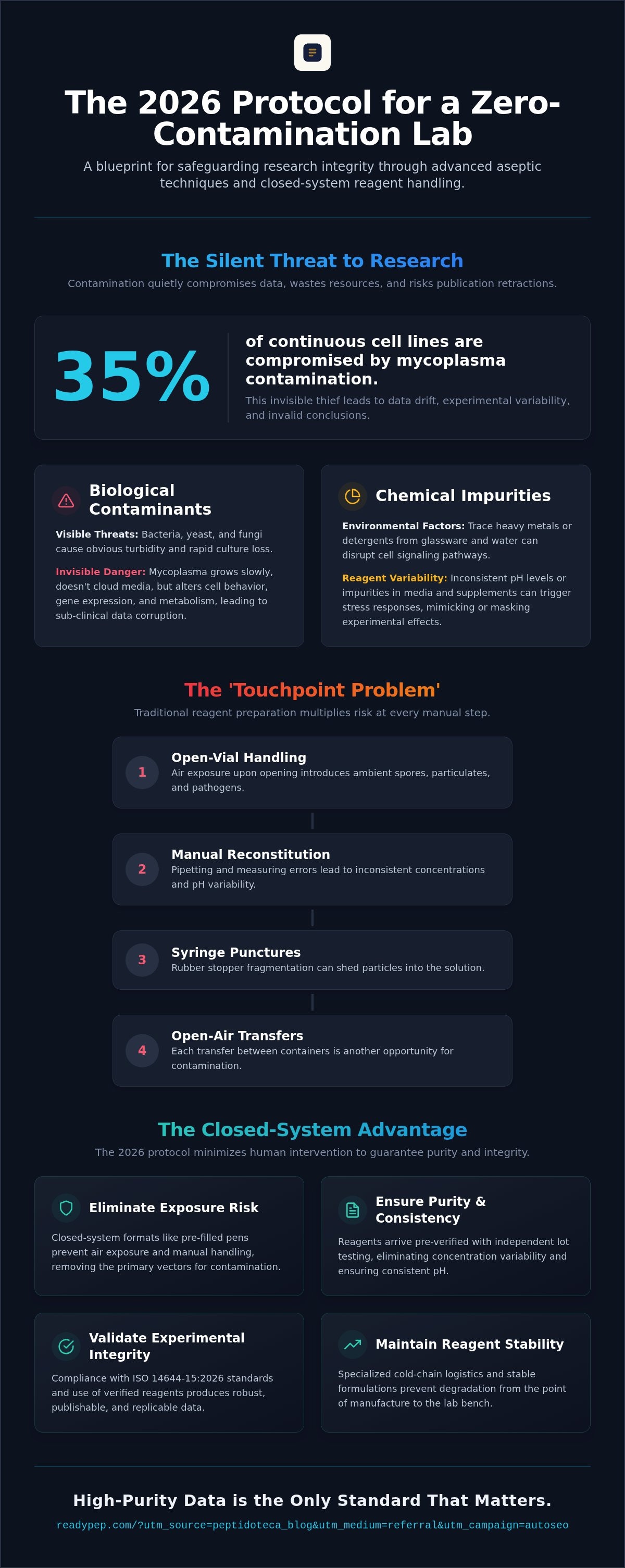
Did you know that up to 35% of continuous cell lines in modern laboratories are currently compromised by mycoplasma? It's a sobering statistic. You've likely felt the frustration of losing an expensive cell line or seeing your data drift due to sub-clinical contamination. It's an invisible thief of time and resources. Reducing contamination in cell culture isn't just about basic hygiene anymore. It's about mastering a closed-loop ecosystem. You need precision. You need verification. Zero risk. Total integrity. This 2026 protocol provides the definitive blueprint for safeguarding your research integrity through advanced aseptic techniques and strategic reagent handling. We'll examine the updated ISO 14644-15:2026 standards and the latest FDA production controls to ensure your facility remains compliant. We also explore how modern delivery systems, such as the pre-filled research formats from ReadyPep, are redefining reagent purity by eliminating manual exposure risks. From real-time environmental monitoring to the removal of reconstitution friction, you'll learn how to achieve a zero-contamination environment. High-purity data is the only standard that matters. Let's secure your path to top-tier publication.
Key Takeaways
- Identify pervasive biological and chemical contaminants to establish a baseline for rigorous, data-driven laboratory hygiene.
- Implement advanced 2026 aseptic protocols focused on reducing contamination in cell culture through optimized laminar flow and PPE standards.
- Minimize the "Touchpoint Problem" by replacing manual reconstitution steps with streamlined, closed-system reagent handling.
- Validate experimental integrity using independent lot testing and specialized cold-chain logistics to prevent reagent degradation.
The Silent Research Killer: Identifying Cell Culture Contaminants
Contamination in the laboratory is a quiet catastrophe. In 2026, the stakes for data integrity have never been higher. A single compromised flask doesn't just represent lost media. It represents months of wasted funding and a potential retraction from top-tier journals. Identifying Cell Culture Contaminants is the first step toward safeguarding your work. You must distinguish between visible disruptions and the sub-clinical shifts that quietly skew your results. Regulators now apply greater scrutiny to compliance gaps, meaning your protocol must be airtight from day one. Failure to maintain these standards results in experimental variability that can derail entire research programs.
Biological vs. Chemical Impurities
Biological agents often announce themselves through rapid growth. Bacteria, yeast, and fungi cause turbidity or visible colonies within 24 to 48 hours. These are the easy problems to solve because they're obvious. The real danger lies in slow-growing agents like Mycoplasma. They don't turn the media cloudy; they just change how your cells behave. Chemical impurities are equally dangerous but frequently overlooked. Trace heavy metals, detergents, or inconsistent pH levels in media and water can disrupt delicate cell signaling pathways. Phenotypic stability depends on using verified, high-purity reagents. This is where precision-manufactured research peptides become critical. If your reagents aren't independently verified, your experimental baseline is already compromised. Reducing contamination in cell culture requires a holistic view of every substance entering the incubator.
Impact on In-Vitro Experimental Validity
Contaminants do more than just kill cells. They alter gene expression, change cellular morphology, and induce metabolic shifts that mimic or mask experimental results. Consider sensitive assays like BPC-157 fibroblast studies. If the environment contains trace endotoxins or Mycoplasma, the observed proliferation rates aren't representative of the compound's effect. They're a reaction to the environmental stressor. Mycoplasma is the leading cause of sub-clinical experimental bias. These sub-clinical changes create dirty data that cannot be replicated by other institutions. In an era of increasing regulatory scrutiny, including the updated ISO 14644-15:2026 standards, you can't afford these variables. Reducing contamination in cell culture is the only way to ensure your findings are both robust and publishable. Every touchpoint is a risk. Every reagent is a potential vector. Efficiency in 2026 means removing these uncertainties before they reach the bench.
Vulnerabilities in Traditional Reagent Preparation
Traditional reagent preparation is riddled with hidden risks. Every manual step is a potential entry point for pathogens. In a typical workflow, a researcher might open a vial, introduce a solvent, pipette the mixture, and then transfer it to a storage container. This "Touchpoint Problem" multiplies the probability of human error. Reducing contamination in cell culture requires us to look beyond the incubator and examine the benchtop itself. If your protocol relies on multiple open-air transfers, you're essentially inviting variability into your assays.
Manual Reconstitution and Air Exposure
Opening a lyophilized vial creates a sudden pressure differential. This often results in the release of aerosols or the intake of ambient air. Even in a certified laminar flow hood, this micro-exchange can introduce spores or chemical particulates. Syringes are another weak link. While sterile, they often require multiple punctures of a rubber stopper, which can shed fragments or allow room air to bypass the seal. Following Advanced Aseptic Protocols helps, but it doesn't eliminate the fundamental flaw of open-vial handling. Manual measuring also introduces volume variability, leading to inconsistent concentrations that ruin assay repeatability.
Reagent Stability and pH Variability
Bulk peptide powders are notoriously difficult to standardize at the bench. If the pH of your reconstituted solution deviates even slightly, it can trigger a stress response in sensitive cell lines. This isn't just about cell death. It's about sub-lethal metabolic changes that skew your data. You must understand the importance of pH testing in aqueous peptide solutions to maintain phenotypic stability. Traditional storage practices also invite trouble. Repeated freeze-thaw cycles degrade peptide integrity and increase the risk of microbial growth in compromised seals. Standardizing your delivery method is the most logical step toward reducing contamination in cell culture. Using pre-filled, multi-dose research pens eliminates the need for manual mixing, effectively closing the aseptic chain and ensuring reagent integrity from the first drop to the last.
Advanced Aseptic Protocols for 2026 Laboratories
Modern aseptic technique is a discipline of movement and management. It's not just about spraying ethanol; it's about controlling every cubic centimeter of air and every surface contact. Reducing contamination in cell culture requires a shift from reactive cleaning to proactive environmental control. By 2026, standard protocols have evolved to include more rigorous PPE and real-time monitoring of cleanroom parameters. You should treat the laminar flow hood as a high-stakes zone where every object has a designated, verified position.
Optimizing the Laminar Flow Environment
Preparation begins with a 15-minute UV cycle followed by a thorough wipe-down with a verified sporicide. Organize your workspace using a "clean-to-dirty" workflow. Place sterile reagents on the left and waste receptacles on the right to prevent air turbulence from carrying contaminants across your cultures. When using advanced delivery systems like pre-filled research peptide pens, follow this specific entry protocol:
- Wipe the exterior pen barrel with 70% Isopropyl Alcohol (IPA) before it enters the hood.
- Transfer the pen to the sterile field using a secondary, IPA-saturated wipe.
- Allow exactly 30 seconds for the alcohol to evaporate completely before engaging the dial.
This protocol ensures that the closed-system benefits of the pen aren't compromised by surface-level impurities. High-sensitivity in-vitro work also demands full-coverage PPE, including dedicated lab coats and double-gloving. While autoclaving remains the gold standard for durable equipment at 121°C, chemical disinfection is necessary for heat-sensitive materials. Implement a weekly cleaning schedule for incubators and water baths, using non-volatile disinfectants to avoid chemical toxicity that can disrupt cell signaling.
Monitoring and Detection Strategies
Don't rely on visual inspection alone. Mycoplasma is often invisible to the naked eye and doesn't cause turbidity. Schedule monthly Mycoplasma PCR testing to catch sub-clinical infections early. You should also implement "antibiotic-free windows" in your culture cycle. Removing antibiotics for 48 to 72 hours unmasks latent contaminants, allowing you to identify issues before they skew your longitudinal data. Reducing contamination in cell culture is an ongoing audit of your environment. It's the only way to guarantee the high-purity data required for elite scientific journals.
The Closed-System Advantage: Pre-filled Peptide Pens
Traditional reagent delivery relies on open-vial systems that expose sensitive compounds to ambient air and human interaction. A closed-system approach fundamentally changes this dynamic by isolating the reagent from the external environment throughout its entire lifecycle. Reducing contamination in cell culture becomes significantly more manageable when you eliminate the air-to-liquid interface exposure that occurs during repeated dosing. Instead of opening a vial every time you need a micro-aliquot, a pre-filled pen maintains a vacuum-sealed environment. This ensures the integrity of the research compound remains uncompromised from the first use to the last. It's a shift from managing risk to eliminating it.
Eliminating the Reconstitution Step
The workflow of lyophilized powder vials is inherently risky. It requires solvent addition, manual agitation, and multiple needle punctures; each step introduces a potential vector for pathogens. In contrast, pre-filled pens arrive ready for immediate use. This streamlined process removes the most common sources of human error and aerosol contamination. For researchers engaged in longitudinal studies, this reduced handling translates directly to lower contamination rates and more reliable data. You can find specific efficiency data on improving lab workflow with pre-filled pens which highlights the time saved and the risk mitigated through this transition. By removing the reconstitution barrier, you secure the aseptic chain before it ever reaches the incubator.
Precision Dosing for In-Vitro Models
Dosing accuracy is as critical as purity. In sensitive assays, such as those measuring the cellular uptake of NAD+, even a minor volume deviation can skew metabolic results. Click-dial mechanisms in modern injectors provide a level of reproducibility that manual pipetting simply cannot match. This precision minimizes reagent waste while maintaining a strictly sterile environment. Integrating ReadyPep pre-filled pens into your laboratory protocol provides a dual benefit: it protects your cell lines from external contaminants and ensures your experimental variables are tightly controlled. If you're serious about reducing contamination in cell culture, transitioning to a closed-system delivery model is the most effective proactive step you can take. Explore the full range of pre-filled research peptide pens to modernize your aseptic workflow today.
ReadyPep Standards: Purity and Integrity for High-Stakes Research
ReadyPep acts as a high-standard gatekeeper for the scientific community. We prioritize empirical verification over marketing hyperbole. Reducing contamination in cell culture requires a supply chain that values transparency above all else. ReadyPep products are not for human or veterinary use. They're intended solely for in-vitro laboratory research by qualified personnel. This distinction is critical for maintaining the rigorous safety and compliance standards required in modern bioscience facilities. We provide the tools you need to ensure your data remains irreproachable from the first assay to the final publication.
Third-Party Verification and Transparency
Transparency is our foundation. While some providers rely on internal data, we prioritize third-party verification to remove the friction of uncertainty. Janoshik Analytical provides the analytical proof for every batch we distribute. This includes independent testing for purity and precise pH levels; we've established these as key factors in maintaining phenotypic stability. You can easily utilize ReadyPep lot numbers for your experimental documentation. This level of peptide research quality assurance is a prerequisite for successful peer review in 2026. It ensures your methodology is backed by verified reagent integrity.
Janoshik's rigorous testing turnaround ensures that compounds like Retatrutide 40mg or MOTS-c 40mg perform exactly as expected. We don't just claim quality; we prove it through data that you can cite. This third-party verification addresses the industry gap where standard certificates of analysis often lack granular detail. By choosing verified reagents, you eliminate the hidden variables that cause experimental drift. It's the most logical step toward securing your publication timeline.
Global Cold-Chain Integrity
Logistics are the silent partner in aseptic work. Temperature fluctuations facilitate microbial growth and degrade delicate peptide chains. ReadyPep eliminates these risks through free worldwide cold-chain shipping. Our pre-filled pens are manufactured by Metatide Healthcare in Switzerland. These facilities adhere to cGMP, ISO 9001, and ISO 17025 standards. This ensures the closed-system integrity discussed in previous sections remains intact during transit. Reducing contamination in cell culture means protecting the compound's analytical profile before it ever reaches your bench.
Metatide Healthcare's precision manufacturing ensures that every Retatrutide 20mg or MOTS-c 40mg pen arrives within a strictly controlled thermal envelope. This prevents the chemical degradation that leads to skewed cellular uptake assays. Verifying cold-chain logs upon arrival is a non-negotiable step in your protocol. We provide the documentation necessary to prove your reagents never left the required thermal range. High-stakes research demands this level of logistical precision. Standardize your results and protect your cell lines from the start.
Secure your research reagents with ReadyPep’s verified pre-filled pens to ensure total experimental control and high-purity results in your next study.
Securing the Future of In-Vitro Integrity
The 2026 laboratory landscape demands more than just basic aseptic habits. It requires a fundamental shift toward closed-system environments and verified reagent purity. By eliminating manual reconstitution steps and adopting precision-engineered delivery formats, you effectively close the most dangerous gaps in your protocol. Reducing contamination in cell culture is no longer a matter of chance; it's a matter of choosing the right tools. You've learned how sub-clinical contaminants like Mycoplasma can quietly erode your data, making third-party verification an absolute necessity for publication-grade research.
ReadyPep provides the transparency and precision your work deserves. Every batch undergoes lot-specific testing by Janoshik Analytical to confirm purity and pH. We secure your supply chain with free worldwide cold-chain shipping, ensuring your reagents arrive sterile and stable. Don't let traditional vial vulnerabilities compromise your next breakthrough. You can explore ReadyPep’s range of independently tested research peptide pens for your next study to standardize your results. Precision is the foundation of discovery. We're here to help you build it with absolute confidence.
Frequently Asked Questions
Can I use antibiotics to permanently solve cell culture contamination?
Antibiotics are not a permanent solution for reducing contamination in cell culture. They often mask low-level infections, particularly Mycoplasma, which can silently alter cellular metabolism without causing visible turbidity. Over-reliance leads to the development of antibiotic-resistant strains and skewed experimental data. You should use them sparingly and implement antibiotic-free periods to unmask latent contaminants. Relying on rigorous aseptic technique and high-purity reagents is the only way to ensure long-term culture integrity.
How do pre-filled peptide pens reduce the risk of Mycoplasma?
Pre-filled peptide pens reduce Mycoplasma risk by maintaining a closed-system environment. Traditional lyophilized vials require manual reconstitution, which involves opening the vial and multiple air-to-liquid interface exposures. Each touchpoint is a potential vector for these sub-microscopic contaminants. By delivering reagents in a vacuum-sealed, multi-dose injector, you eliminate the manual mixing steps where most aerosol-based contamination occurs. This protects the compound's analytical profile throughout its entire research lifecycle.
What is the most effective way to disinfect a peptide pen before lab use?
The most effective method is a thorough wipe-down with 70% Isopropyl Alcohol (IPA) before the pen enters the laminar flow hood. You must ensure the entire exterior barrel is saturated. Allow exactly 30 seconds for the alcohol to evaporate completely before use. This prevents surface-level pathogens from hitchhiking into the sterile field. Don't submerge the pen in liquid disinfectants, as this could compromise the internal mechanical components of the precision injector.
Is pH testing necessary if the peptide is research-grade?
Yes, pH testing remains critical even for research-grade peptides. Minor deviations in acidity or alkalinity can trigger cellular stress responses, leading to metabolic shifts or cell death. ReadyPep addresses this by coordinating independent pH verification through Janoshik Analytical for every batch. This ensures that the aqueous solution is compatible with your specific in-vitro models. Using verified reagents removes the burden of benchtop testing and ensures your experimental baseline remains consistent across all replicates.
How does cold-chain shipping prevent contamination of research chemicals?
Cold-chain shipping prevents contamination by maintaining a thermal envelope that inhibits microbial growth and prevents peptide degradation. Temperature fluctuations can compromise the physical integrity of seals and encourage the proliferation of opportunistic pathogens. ReadyPep provides free worldwide cold-chain shipping to ensure that every pre-filled pen remains stable from the manufacturing floor to your laboratory. Verifying this thermal integrity upon arrival is a vital step in reducing contamination in cell culture protocols.
What should I do if I suspect my cell culture is contaminated?
Isolate the suspect flasks immediately to prevent cross-contamination within the incubator. You should perform a PCR-based Mycoplasma test and visual checks for turbidity or fungal colonies. If contamination is confirmed, discard the cultures as biohazardous waste. Don't attempt to "cure" them with high-dose antibiotics. Perform a deep clean of the incubator using a verified sporicide and review your reagent handling protocols to identify the breach in the aseptic chain.
Why is independent third-party testing critical for in-vitro reagents?
Independent third-party testing provides unbiased verification that a reagent meets its stated analytical profile. ReadyPep utilizes Janoshik Analytical to test every lot for purity and pH; this goes beyond standard manufacturer certificates of analysis. This radical transparency is essential for publication integrity. It ensures that your experimental variables aren't compromised by chemical impurities. Using independently verified reagents like those found at ReadyPep safeguards your research against the hidden risks of unverified supply chains.
How long can a pre-filled research pen be stored once opened?
Storage duration depends on the specific compound and its stabilization profile. Generally, pre-filled research pens remain stable under refrigeration for the duration of most standard in-vitro studies. You should always refer to the lot-specific documentation provided by ReadyPep for precise shelf-life data. The closed-system design helps extend stability by preventing repeated air exposure, but maintaining a consistent cold-chain environment in your laboratory is essential to prevent degradation or microbial colonization over time.
Disclaimer
Educational content only. Not medical advice.


