

Did you know that most research peptides lose up to 10% of their potency within just 30 days of activation? This degradation isn't just a technicality. It's the difference between a breakthrough and a failed experiment. Understanding peptide stability after opening pen is critical for maintaining reagent integrity. It prevents the high cost of wasted materials. You've likely felt the frustration of inconsistent data. Often, the culprit is undetected breakdown rather than experimental variables. It's time to remove that uncertainty and restore confidence in your results.
This guide provides the clinical precision you need to manage your inventory with confidence. We'll explore specific stability windows for activated pens. We'll examine how bacteriostatic preservatives and temperature fluctuations impact longevity. You'll learn practical protocols to extend shelf life. We'll also cover the verification methods necessary to confirm peptide integrity before every trial. By the end, you'll have a streamlined framework for protecting your research from the silent threat of chemical degradation. Precision starts with data. Let's look at the facts.
Key Takeaways
- Identify the primary chemical pathways, including hydrolysis and oxidation, that initiate reagent degradation immediately following the first activation click.
- Master the critical factors governing peptide stability after opening pen to eliminate experimental variability and prevent the high cost of wasted materials.
- Implement precise storage protocols using calibrated refrigeration and aseptic handling to maximize the 30- to 60-day stability window of aqueous research reagents.
- Understand the structural advantages of pre-filled research pens in minimizing air ingress and contamination compared to traditional manual vial reconstitution.
- Learn how to utilize independent lot-specific testing and analytical documentation to verify the integrity of your compounds throughout the duration of your study.
Understanding Peptide Degradation Kinetics Post-Activation
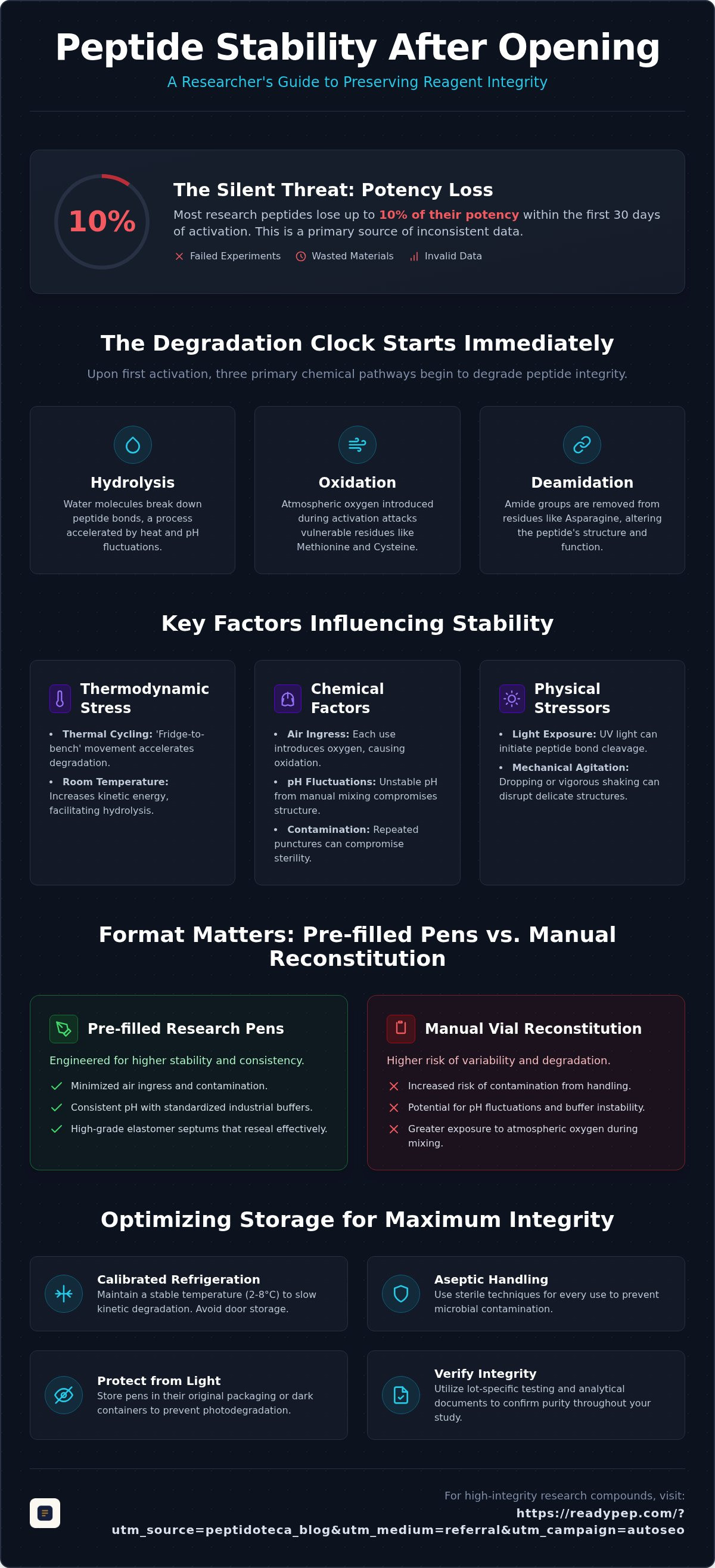
Peptide stability is the duration a compound retains >98% of its specified purity. In a laboratory setting, this metric determines the validity of your data. Once a pen is activated, the degradation clock begins immediately. The primary pathways involve hydrolysis, oxidation, and deamidation within the aqueous environment. These reactions aren't instantaneous but they are cumulative. The chemical shifts that occur dictate the peptide stability after opening pen. A loss of just 5% potency can skew metabolic research results and lead to false negatives in your trials.
The first click of the pen is a thermodynamic catalyst. It breaks the factory seal. It introduces atmospheric oxygen. It also creates a physical bridge for contaminants via the needle interface. This event significantly impacts peptide stability after opening pen. Research from 2026 shows that most reconstituted peptides lose 5-10% of their potency within the first 30 days. This decline isn't linear. It accelerates as the chemical environment within the reservoir shifts and buffers begin to lose their efficacy.
Thermodynamic factors play a silent but destructive role. Room temperature exposure during research sessions increases molecular kinetic energy. This energy facilitates peptide bond degradation through hydrolysis. While a 30-minute session might seem negligible, the cumulative effect is real. Heat triggers hydrolysis. It also speeds up deamidation, where an amide group is removed from the peptide chain. This changes the molecule's charge and function, often rendering it inert for specific receptor binding assays.
Chemical Vulnerabilities of Aqueous Solutions
Aqueous solutions are inherently more volatile than lyophilized powders. Specific amino acid residues are particularly vulnerable to environmental stressors:
- Methionine and Cysteine: Highly prone to oxidation from light or dissolved oxygen introduced during activation.
- Asparagine and Glutamine: Frequent targets for deamidation, altering the peptide's primary structure and biological activity.
Maintaining a precise pH is vital for the secondary structure of research compounds. Pre-filled pens maintain a more consistent pH than manually reconstituted vials. This is because industrial manufacturing uses standardized buffers. Manual handling often introduces pH fluctuations that destabilize the peptide sequence. You can find high-integrity options in the ReadyPep inventory.
The 'First-Opening' Effect on Sterility
Sterility is the first line of defense. The first opening introduces atmospheric contaminants. Multi-dose pen membranes are engineered to mitigate this. They use high-grade elastomers that reseal after every puncture. This technology minimizes bacterial entry compared to open-vial systems. However, repeated septum punctures eventually compromise the seal. Every use introduces a microscopic amount of air. This air ingress contributes to the oxidation mentioned earlier. Consistency in your protocol is the only way to manage these variables effectively. Every puncture is a calculated risk to the internal reservoir's integrity.
Factors Influencing Peptide Stability in Pre-filled Pens
Physical stressors impact molecular integrity as much as chemical kinetics. Light sensitivity remains a primary concern in laboratory environments. Ultraviolet (UV) exposure initiates peptide bond cleavage. This process breaks the amino acid chain, rendering the compound biologically inactive. Photodegradation can occur within hours if reagents are left in transparent containers. Mechanical stress is another overlooked variable. Dropping a pen or subjecting it to vigorous agitation can disrupt delicate secondary structures. While peptides are generally more robust than large proteins, they still require gentle handling to maintain peptide stability after opening pen.
Thermal cycling presents a significant risk to reagent longevity. The 'fridge-to-bench' cycle creates kinetic spikes. Moving a compound from 2°C to 22°C accelerates the rate of hydrolysis and oxidation. These fluctuations introduce condensation risks and alter the solution's thermodynamic equilibrium. Maintaining a stable environment is essential for reproducible data. Aligning your lab protocols with FDA drug stability guidelines ensures that storage conditions don't become a hidden variable in your research.
Preservatives and the 28-Day Rule
Standard laboratory protocols often mandate a 28-day limit for multi-dose aqueous reagents. This rule is primarily centered on preservative efficacy. Bacteriostatic agents like benzyl alcohol are essential for post-opening stability. They inhibit microbial growth introduced during the first puncture. However, these agents have limitations. They prevent biological contamination but don't stop purely chemical degradation. Even in a sterile environment, peptide stability after opening pen declines as hydrolysis continues. Research indicates that most peptides lose 5-10% of their potency within the first 30 days of reconstitution. Some specifically engineered analogues may extend this window to 56 days, but the 28-day benchmark remains a safe standard for high-precision trials.
Environmental Exposure Mitigation
Modern pen design serves as a protective barrier against environmental stressors. Opaque housings are critical. They block the light that triggers photodegradation. The vacuum-sealed nature of pre-filled systems also limits oxygen interaction. This is a significant advantage over manual vials, where every draw introduces fresh atmospheric air. To further protect your reagents, optimize your workflow to minimize 'out-of-fridge' time. Researchers aiming for maximum experimental integrity often utilize pre-filled research pens to eliminate the variables associated with manual handling and atmospheric exposure.
Stability Data: Shelf Life of Aqueous Peptides vs. Lyophilized Vials
Lyophilized peptides in sealed vials offer theoretical longevity, often maintaining integrity for 24 to 36 months when stored at -20°C. However, this stability is lost the moment a researcher introduces a diluent. Manual reconstitution is an error-prone process. It introduces atmospheric oxygen, potential contaminants, and pH variability. These factors drastically shorten the usable window. In contrast, pre-filled pens are manufactured in controlled environments to ensure peptide stability after opening pen remains predictable. Standardized aqueous formulations eliminate the "reconstitution risk" where improper swirling or aggressive agitation can fracture delicate molecular chains before the first assay even begins.
Lot-to-lot consistency is a prerequisite for high-fidelity research. When using manually prepared vials, the purity of the final solution depends entirely on the technician's technique and the quality of the bacteriostatic water used. Pre-filled reagents bypass these variables. Every batch undergoes rigorous verification, as detailed in our guide on Peptide Pen Quality Control. This industrial precision ensures that the degradation kinetics follow a known curve rather than a random trajectory influenced by lab-level handling errors.
Stability Timelines for Common Research Compounds
Different chemical structures exhibit unique degradation profiles. Metabolic research compounds, such as Retatrutide 40mg, are often engineered for enhanced stability. These GLP-1 analogues can maintain potency for up to 56 days under strict refrigeration. Neuroscience reagents require even closer monitoring. A compound like Selank 10mg is highly sensitive to enzymatic breakdown and pH shifts. High-concentration solutions, including NAD+ 1000mg, present another challenge. The increased solute density can lead to precipitation or accelerated oxidation if the peptide stability after opening pen isn't managed through consistent thermal control.
Quantifying the Cost of Reagent Degradation
Failed in-vitro assays represent a massive financial drain. When a reagent loses just 10% of its potency, the resulting data becomes statistical noise. This forces researchers to repeat trials, doubling the cost of both materials and labor. Pre-filled pens improve ROI by extending the usable shelf life through superior engineering. The vacuum-sealed reservoir and opaque housing mitigate the primary drivers of breakdown. Switching from traditional vials to precision pens is a logical step for laboratories prioritizing data integrity. It moves the focus from "managing degradation" to "executing research." Precision reagents are the foundation of reproducible science. They ensure your budget is spent on discovery, not on replacing expired materials.
Optimizing Storage Protocols for Maximum Reagent Integrity
Aseptic technique is non-negotiable. Wipe the rubber septum with 70% isopropyl alcohol before every needle attachment. This simple step prevents microbial transfer from the environment into the reservoir. Dedicated laboratory refrigeration is essential. Household fridges fluctuate too much. Use a calibrated thermometer to ensure a consistent 2-8°C range. Store pens in the center of the unit, never in the door. Door storage subjects the reagent to constant thermal shocks. Positioning also matters. Store pens horizontally. This prevents the internal plunger mechanism from experiencing uneven pressure. It also ensures the solution remains in contact with the septum, preventing it from drying out. Optimizing these variables is the only way to maintain peptide stability after opening pen over a 30-day window.
The Cold Chain Continuity Protocol
Baseline stability depends on the transit from the manufacturer to your bench. ReadyPep utilizes specialized cold-chain shipping from the UK to maintain thermal integrity. Upon receipt, verify that the package is still chilled. If the shipment arrived at room temperature, the peptide stability after opening pen is already at risk. During assays, keep the pen in a chilled block. Return it to refrigeration immediately after use. Minimize ambient exposure to prevent the kinetic spikes that trigger hydrolysis. For broader compliance standards, consult our guide on Long-Term Stability and Storage.
Detecting Reagent Failure: A Researcher’s Checklist
Visual inspection is your first diagnostic tool. Any deviation from a clear, colorless state is a red flag. These changes indicate that the chemical environment has shifted beyond the point of reliability.
- Cloudiness: Indicates bacterial contamination or significant peptide aggregation.
- Precipitation: Visible particles suggest the compound has crashed out of the aqueous buffer.
- Discoloration: Yellowing or tinting often points to advanced oxidation.
If your in-vitro data deviates from established baselines, consider chemical verification. A spot-check HPLC can confirm if purity has dropped below the 98% threshold. Follow the 'When in Doubt, Dispose' rule. Using degraded reagents is more expensive than replacing them. It invalidates your entire data set. To ensure your research remains beyond reproach, source your materials from a provider of precision-engineered research pens.
ReadyPep’s Precision Engineering: Ensuring Lot-to-Lot Stability
ReadyPep positions itself as a disruptor by prioritizing empirical verification over industry norms. Every reagent in our inventory follows the Metatide Healthcare manufacturing standard. This isn't just a label. It's a commitment to clinical-grade precision for in-vitro research. By utilizing standardized delivery systems, we reduce the experimental variables that plague traditional lab settings. This approach is fundamental to maintaining peptide stability after opening pen. When the starting purity is verified at the highest level, the degradation curve becomes a predictable metric rather than a source of data corruption. Consistent reagents lead to consistent results.
The pen mechanism itself is a feat of engineering designed to protect the internal reservoir. Unlike traditional vials that expose the entire contents to the atmosphere with every draw, our pens use a specialized plunger system. This system maintains a physical barrier between the reagent and the external environment. This significantly mitigates the oxidation risks discussed in previous sections. It ensures that the peptide stability after opening pen remains within the 30- to 60-day window expected of high-performance aqueous solutions.
Analytical Verification of Purity and pH
Transparency is our baseline. Every batch undergoes independent lot testing by Janoshik Analytical. We provide researchers with the exact HPLC and Mass Spectrometry documentation for their specific lot. This level of detail is vital for publication integrity. It allows you to account for every variable in your methodology. Precise pH control is a core feature of ReadyPep engineering. By locking the solution into an optimal pH range at the factory, we prevent the premature degradation often caused by improper manual buffering. You can access these lot-specific records to ensure your laboratory logs are beyond reproach. We don't ask for trust; we provide the data.
Streamlining the Research Workflow
Removing the reconstitution step eliminates the primary source of peptide instability. Manual handling introduces air, contaminants, and mechanical stress that fracture peptide chains before research begins. High-purity pens allow you to move directly from storage to the bench with zero friction. This efficiency is explored further in our guide on Improving Lab Workflow. By choosing a pre-filled format, you bypass the errors of manual preparation. You secure a reagent that is ready for immediate application. Data-driven research requires uncompromising standards. If you value reproducibility and reagent longevity, you need tools engineered for the modern laboratory. You can secure high-purity research reagents with verified stability profiles here to protect your study's integrity.
Securing Reproducibility Through Analytical Rigor
Precision in research requires more than just high-purity compounds; it demands a deep understanding of how those molecules behave in a laboratory environment. We've identified that the first activation click initiates a complex chemical countdown. Managing peptide stability after opening pen is the only way to ensure your metabolic or neurological data remains statistically significant. By eliminating the high-risk manual reconstitution step and implementing strict thermal monitoring, you remove the primary drivers of reagent failure. Data integrity is the foundation of scientific progress.
ReadyPep provides the tools to maintain this standard. Every lot is independently verified by Janoshik Analytical for purity and pH. We utilize precision-engineered Metatide Healthcare pens to shield your compounds from atmospheric and mechanical stressors. With free global cold-chain shipping, we ensure your reagents arrive with their molecular structure intact. It's time to move beyond the uncertainty of manual vials. You can optimize your research with pre-filled, lot-verified peptide pens from ReadyPep and focus on the discovery ahead. Your breakthroughs deserve the highest level of verification.
Frequently Asked Questions
How long does a peptide pen last after the first click?
Most reconstituted research peptides maintain integrity for 30 to 60 days when refrigerated at 2-8°C. The specific window depends on the compound's chemical structure. For instance, GLP-1 analogues may remain stable for up to 56 days. However, the 28-day rule is a standard laboratory benchmark for multi-dose aqueous reagents. Beyond this point, chemical degradation often exceeds the 2% threshold, which can compromise experimental reproducibility and reagent integrity.
Can I freeze a pre-filled peptide pen to extend its shelf life?
Freezing a pre-filled aqueous pen is not recommended and can damage both the peptide and the pen mechanism. The formation of ice crystals during the freezing process can fracture delicate peptide chains. Additionally, the expansion of the liquid may compromise the internal plunger or the glass reservoir. Repeated freeze-thaw cycles are particularly destructive. For long-term storage of unactivated pens, maintain a consistent refrigerated environment at 2-8°C.
What happens if a peptide pen is left at room temperature for 24 hours?
Brief exposure to room temperature generally causes minimal degradation, but it does accelerate the rate of hydrolysis. Most stabilized aqueous solutions can tolerate transit or temporary bench-top use for 24 hours without significant potency loss. However, cumulative thermal spikes reduce the overall duration of peptide stability after opening pen. If the pen was exposed to extreme heat above 30°C, the risk of deamidation increases, potentially rendering the compound inert.
Why does the solution in my peptide pen look cloudy after two weeks?
Cloudiness is a visual indicator of reagent failure, typically caused by bacterial contamination or peptide aggregation. If the solution is no longer clear and colorless, it indicates that the chemical environment has shifted or the bacteriostatic agent has been overwhelmed. Aggregation occurs when peptides lose their secondary structure and clump together. Using a cloudy reagent will invalidate in-vitro data. Dispose of the pen immediately to maintain research integrity.
Do all research peptides have the same stability profile after opening?
Stability profiles vary significantly based on the amino acid sequence and concentration. Metabolic peptides like retatrutide are often engineered for enhanced longevity in solution. Conversely, neurological reagents like Selank or Semax are more sensitive to enzymatic breakdown and pH fluctuations. High-concentration solutions, such as NAD+ 1000mg, may also exhibit faster degradation curves. Always consult the lot-specific documentation provided by ReadyPep to understand the unique kinetics of your specific compound.
How can I verify the purity of my peptide pen lot?
Verification is achieved through lot-specific analytical documentation. ReadyPep utilizes independent testing by Janoshik Analytical for every batch of Metatide Healthcare pens. Researchers can access HPLC and Mass Spectrometry reports that confirm the exact purity and pH levels. This transparency is essential for publication integrity. It allows you to verify that your reagents meet the necessary standards before initiating any in-vitro laboratory research or metabolic study.
Is it necessary to use a new needle for every click in a research setting?
Yes, using a sterile, single-use needle for every activation is mandatory to prevent contamination. Reusing needles introduces microscopic debris and environmental bacteria into the reservoir. This compromise directly impacts peptide stability after opening pen by overwhelming the bacteriostatic preservatives. Aseptic technique is the first line of defense in protecting reagent longevity. Always wipe the septum with 70% isopropyl alcohol before attaching a new needle to maintain a sterile interface.
What is the impact of bacteriostatic water on peptide integrity over time?
Bacteriostatic agents like benzyl alcohol prevent microbial growth but don't stop chemical degradation pathways. While they allow for multi-dose usage over a 28-day period, the presence of the preservative can slightly alter the solution's pH. Over several months, these agents can contribute to the gradual breakdown of the peptide through oxidation or hydrolysis. This is why aqueous solutions have a much shorter shelf life than lyophilized powders stored at sub-zero temperatures.
Disclaimer
Educational content only. Not medical advice.


