

The dose is not one universal number. In a controlled study of healthy men, intravenous kisspeptin-10 boluses ranged from 0.01 to 3.0 mcg/kg, while other human studies tested different doses and routes. A Kisspeptin-10 research pen is a research product, not a translation of those study protocols into a human-use dose.
It’s reasonable to look for a simple dose comparison, but route, study design, and participants all shape the LH response. This article explains the human-study dose context, why LH responses varied, and what FDA status and product documentation can establish.
You’ll see how to interpret findings without treating research doses as instructions, what purity and batch documentation can tell you, and how a research pen differs from a clinical protocol. The focus is precision: study data on one side, product identity and documentation on the other.
Key Takeaways
- Kisspeptin-10 is not FDA-approved; human study doses describe specific research protocols, not directions for use.
- LH responses varied with dose, route, study design, and participant group, so one result cannot stand in for every protocol.
- Product documentation can help distinguish compound identity, stated purity, and batch-specific results.
- A research pen’s product labeling and listed contents are separate from clinical evidence about human dosing.
- For readers exploring other research peptide formats, ReadyPep offers Retatrutide 20mg alongside other listed research products.
FDA approval status
Kisspeptin-10 is not FDA-approved. That status matters when interpreting human-study findings: a measured hormone effect does not establish an approved treatment, a recommended dose, or a safety profile for general use. The compound’s role in research and its regulatory status are separate questions.
Human studies examine specific protocols, participants, and outcomes. For example, investigators have studied kisspeptin-10 signaling through changes in luteinizing hormone (LH), a hormone involved in reproductive signaling. Those results describe the conditions tested. They don’t establish that a research product is approved for human use or that the same response applies across different settings.
One controlled study administered continuous intravenous kisspeptin-10 at 4 mcg/kg/h for 22.5 hours, according to The underlying study's authors. That protocol is a study detail, not a general dosing instruction. Its route, duration, and monitored setting distinguish it from a research pen labeled for laboratory research only and not for human or veterinary use.
The distinction is practical. Research findings can help scientists examine hormone release, dose response, and biological signaling. They cannot, by themselves, establish the regulatory status of a particular product. Nor does an observed effect in one protocol show that repeated exposure has been assessed across different populations or conditions.
How much do kisspeptin-10 research pens cost, and how do prices compare? There is no study-based price comparison: research papers report protocols and outcomes, not retail pricing. For a meaningful product comparison, consider the labeled amount, format, and included components rather than treating human-study doses as a price benchmark.
What safety risks and side effects are known for kisspeptin-10? The controlled study described above measured blood pressure, pulse, and peripheral oxygen saturation every 3 minutes. Those measurements show what researchers monitored, but they don’t establish a complete side-effect profile or prove safety for human use.
When assessing a product description, separate three questions: Is the compound identified? Is the product labeled for research use? Does the label claim human approval? A laboratory-only label is not equivalent to FDA approval. Likewise, a study protocol cannot turn a research product into an approved medicine.
Keep the interpretation narrow. The 22.5-hour infusion documents an experimental protocol, while the FDA status remains unapproved. Human-study results can inform research questions, but they should not be used as personal dosing guidance or as evidence that repeated use is safe.
LH response and dose dependency
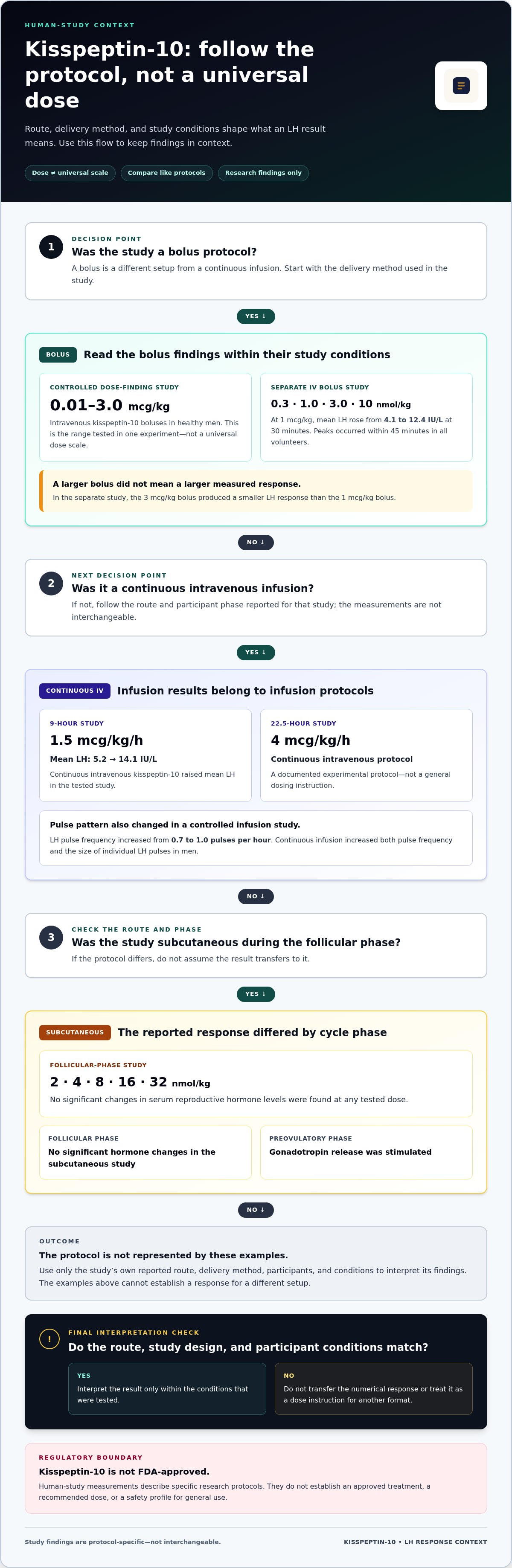
Human studies show that kisspeptin-10 can stimulate luteinizing hormone (LH), but the response depends on dose, route, and study conditions. In a controlled intravenous dose-finding study in healthy men, boluses ranged from 0.01 to 3.0 mcg/kg. This range describes one experiment, not a universal dose scale.
A separate study tested intravenous boluses of 0.3, 1.0, 3.0, or 10 nmol/kg in healthy men. At 1 mcg/kg, mean LH rose from 4.1 to 12.4 IU/L at 30 minutes. Peaks occurred within 45 minutes in all volunteers. The 3 mcg/kg bolus produced a smaller LH response than the 1 mcg/kg bolus, showing that a larger amount did not produce a larger measured effect.
Study design also matters. In the 2011 dose-ranging study, the bolus arm enrolled 6 healthy men, while each infusion arm enrolled 4. In another controlled study, continuous intravenous kisspeptin-10 at 1.5 mcg/kg/h for 9 hours raised mean LH from 5.2 to 14.1 IU/L. Infusion findings therefore can’t be read as direct equivalents of bolus findings.
Researchers also observed changes in LH pulse patterns. During a controlled infusion study, pulse frequency increased from 0.7 to 1.0 pulses per hour. Continuous infusion increased both pulse frequency and the size of individual LH pulses in men. These results describe hormone patterns under the tested conditions, rather than a predictable response for every person.
Route shifted results in women. During the follicular phase, intravenous doses of 1.0, 3.0, or 10 nmol/kg were tested. A separate subcutaneous study tested 2, 4, 8, 16, or 32 nmol/kg and found no significant changes in serum reproductive hormone levels at any tested dose. In contrast, kisspeptin-10 stimulated gonadotropin release during the preovulatory phase, but not during the follicular phase.
That contrast is important: dose alone doesn’t explain the response. Route, menstrual-cycle phase, and whether researchers used bolus or continuous infusion all shape what the measurements show. Kisspeptin-10 may be potent in a specific experimental setup, but results across humans aren’t interchangeable. A dose reported in one protocol cannot be converted into instructions for a different format.
To keep product format separate from study dosing, use the study data as experimental context, not as a use guide. Readers comparing research peptide formats can review the research peptide product range as a distinct category from clinical protocols.
Purity and product documentation
Product records address different questions: identity, stated purity, and assay activity are related, but not interchangeable. Read each value alongside the label and the specific material it describes.
Purity and Product Records
A listed Kisspeptin-10 product gives a stated purity of at least 99% and CAS number 374675-21-5. Separate listings report 99.86% purity, while a listed batch reports 99.98%. These values describe distinct product or batch records. Don’t treat them as one universal measurement or assume a batch figure applies to every lot.
Start by matching the compound name and CAS number, then note whether the purity result applies to a general listing or a named batch. A batch-specific result is tied to that batch, while a general product statement describes the listing. Purity alone doesn’t establish regulatory approval, intended use, or biological performance.
Listed Ingredients, Concentration, and Dose
The listed Kisspeptin-10 product has molecular formula C63H83N17O14 and molecular weight 1302.45 g/mol. A separate human Kisspeptin-10 listing describes solubility in water at 10 mg/mL, equivalent to 7.68 mM, with ultrasonic assistance needed. These are product and handling descriptors, not evidence of a human-use dose.
Keep amount, concentration, and dose distinct. A stated 10 mg product amount refers to total compound listed; 10 mg/mL describes concentration in solution. Neither figure establishes how much a person should use. Product documentation should be interpreted as labeling information, not as a clinical protocol.
Laboratory assay results add another layer, but they answer a different question from purity testing. Kisspeptin-10 agonist activity at human GPR54 expressed in CHO cells has a reported EC50 of 0.24 nM. Its displacement of radiolabeled kisspeptin-15 from human GPR54 in CHO cell membranes has a reported IC50 of 0.07 nM. EC50 and IC50 are assay-specific measures, not percentages of purity.
GPR54 is also known as KISS1R, the receptor associated with kisspeptin signaling. A measured receptor response indicates activity under the stated laboratory conditions. It doesn’t prove that separate lots have identical composition or predict an outcome in humans. Compare assay descriptions carefully, since cell systems and measured endpoints differ.
For a practical reading sequence, identify the compound and CAS number first, then distinguish a general purity claim from a batch result. Next, separate formula, total amount, and solution concentration from receptor assay values. This helps prevent a strong-looking assay number from being mistaken for a purity percentage or dosing instruction.
What is a kisspeptin-10 research pen and how is it marketed?
A Kisspeptin-10 research pen is a peptide product presented in pen format for laboratory research. The format describes how the product is packaged, not an approved clinical use or a human dosing protocol. Its label states that it is for laboratory research only and not for human or veterinary use.
That label should guide interpretation of every product claim. Human studies investigate kisspeptin-10 under specific experimental conditions, while a research pen is marketed for laboratory research. Those are distinct contexts. A pen’s presence, design, or labeled amount doesn’t establish FDA approval or show that it reproduces a published study protocol.
Product descriptions list the Kisspeptin research pen as containing 10 mg of kisspeptin. That amount identifies the stated total content, not a dose for a person or a measure of study equivalence. Likewise, the pen format doesn’t show how a controlled study prepared, administered, or monitored its compound. Read the declared content alongside the research-only label.
Packaging details can clarify what the listing includes. The listed Kisspeptin research pen is supplied with 5 pen needles. That is a packaging detail, not evidence of clinical suitability. Storage information is also specific: the pen is listed for storage at 2-8°C, kept dry and protected from light. These conditions describe the product listing and should not be confused with study handling procedures.
Marketing language can be read in three steps:
- Identify the stated purpose. “Laboratory research only” defines the described context; it doesn’t imply human or veterinary use.
- Separate format from protocol. A pen is a product format, while a published study specifies its own route, amount, and conditions.
- Read the declared contents and handling information. The 10 mg listing, 5 included needles, and 2-8°C storage statement describe separate product details.
These distinctions help prevent a familiar category error: treating a convenient delivery format as evidence of therapeutic status. A pen label can document how the product is marketed, its stated contents, and listed storage conditions. It cannot establish FDA approval, reproduce human-study outcomes, or turn research findings into personal instructions. The most reliable reading keeps each claim within its stated scope.
For a laboratory researcher, the product description is therefore a starting point for identifying format and label claims, not a substitute for experimental design. The 10 mg content and 2-8°C storage listing answer product-description questions; they do not establish a clinical dose, efficacy, or safety for human use.
What ingredients, concentration, and dose are listed for kisspeptin-10 research pens?
Product labels use several measurements that answer different questions. Total peptide amount describes the listed contents, concentration describes peptide per volume, and dose describes an amount administered in a protocol. A Kisspeptin-10 research pen listing gives a total content of 10 mg. That figure is product information, not a human-use dose.
For formulation context, qualifying products include 3 ml of reconstitution solution made with sterile water and 0.9% benzyl alcohol. The wording matters: this solution detail applies to qualifying products, not automatically to every Kisspeptin-10 listing. Read the product’s stated contents as a specific formulation description, rather than assuming all formats share identical ingredients.
Concentration is a separate measurement. A human Kisspeptin-10 product is listed as soluble in water at 10 mg/mL, equivalent to 7.68 mM, with ultrasonic assistance needed. This describes a solubility listing, not the concentration of every pen. Nor does it establish how a pen should be used or how much should be administered.
The listed molecular formula, C63H83N17O14, identifies the peptide’s chemical composition. Its molecular weight is 1302.45 g/mol. These identifiers help distinguish chemical identity from formulation details such as solution volume or concentration. A separate 0.1 mg sample size is listed for the human Kisspeptin-10 product; it is a sample amount, not a pen dose.
Keep the information in separate categories:
- Compound identity: the listed molecular formula and molecular weight describe the peptide.
- Total amount: the pen listing states 10 mg of Kisspeptin.
- Solution details: qualifying products include 3 ml of sterile-water solution with 0.9% benzyl alcohol.
- Concentration context: the 10 mg/mL and 7.68 mM values belong to a solubility listing.
These distinctions prevent a common mix-up: total content is not concentration, and neither is an administration dose. Research protocols specify their own route and amount; a product listing does not turn those experimental details into directions. The pen is labeled for laboratory research only, not for human or veterinary use.
For a clear product comparison, match the format to its stated contents and keep each measurement in its proper category. Explore the research peptide formats with the distinction between product specifications and study protocols in mind.
ReadyPep: Retatrutide 20mg
ReadyPep is a natural next step when your research interests extend beyond kisspeptin-10 to other listed peptide compounds. Its offerings include Retatrutide 20mg and Retatrutide 40mg, alongside MOTS-c 40mg and BPC-157 + TB-500 40mg. Each is a distinct research product, so keep compound identity and product documentation separate when comparing options.
Use the study context in this article to distinguish human research findings from product specifications. Then explore ReadyPep’s research products if you’re considering a compound for laboratory research. The products are not presented for human or veterinary therapeutic use.
Visit ReadyPep to explore its research products.
Make your next research decision with clarity
Use the questions raised by a Kisspeptin-10 research pen as a starting point for a more disciplined research plan. Before comparing options, define what your work needs to answer and which product characteristics matter to that work. Keeping the research objective in focus makes product exploration more deliberate and helps separate useful specifications from assumptions.
ReadyPep provides a place to continue that exploration across its research product range. If you have questions about the available offerings, contact the team directly through the site. The next step can be a simple one: clarify what you’re looking for, then review the information with that purpose in mind.
Contact ReadyPep with your questions, and move forward with a clear research focus.
Frequently Asked Questions
What dose of kisspeptin-10 was used in human studies?
Human studies used protocol-specific doses, not one standard amount. To interpret a study, identify its route, administration pattern, participant group, and measured outcome before comparing dose values. Keep the study’s units intact, too: a value reported by body weight cannot be directly compared with a total amount listed for a product. Study dose context is not personal dosing guidance.
What is Kisspeptin-10?
Kisspeptin-10 is a short peptide form of kisspeptin, consisting of ten amino-acid residues. The “10” distinguishes this peptide form from longer kisspeptin forms. In laboratory settings, researchers can study its interactions with target receptors and the resulting cellular signals. That molecular description identifies the compound; it doesn’t, by itself, establish a product’s formulation, intended use, or clinical status.
What is kisspeptin-10 and what does research say about its effects?
Research examines kisspeptin-10’s effects by measuring biological responses under defined experimental conditions. Interpret each reported outcome according to what the investigators measured: a change in a hormone marker is not the same as a demonstrated clinical benefit. For useful context, compare the study’s objective, participants, and observation period, then keep conclusions limited to those measurements rather than extending them to untested outcomes.
What clinical studies have tested kisspeptin-10 in humans?
Human studies have examined kisspeptin-10 in controlled experiments focused on reproductive hormone responses. When reviewing a paper, distinguish dose-finding work from studies designed to compare participant groups or cycle phases. Check which outcome the investigators measured and whether the reported result was statistically significant. Those details help explain what a study can support without treating every experiment as evidence for the same clinical use.
Are these research pens FDA-approved for human use?
No. A research pen is not FDA-approved for human use. A paper describing human research on a compound does not establish approval for a specific product. Keep those records separate: study findings describe an experiment, while product labeling identifies its stated research context. Neither should be read as authorization to use a laboratory product as a medicine.
Can consumers legally buy or import kisspeptin-10 research products in the United States?
A research-only label does not itself establish that consumer purchase or import is legally permitted in the United States. The answer depends on applicable rules and the circumstances of the transaction, including the product and its intended use. Don’t treat an online listing, shipment offer, or laboratory label as proof of personal-use eligibility or import permission.
How can buyers evaluate the purity, testing, and legitimacy of a kisspeptin-10 supplier?
Start by checking whether product identity, lot identifiers, and testing records match across the listing and accompanying documents. Read the stated analytical method and result type carefully, and distinguish a general product claim from a result tied to a particular lot. Also look for a clear distinction between the supplier’s role and the manufacturer’s role. Consistent records make claims easier to interpret and compare.
What safety risks and side effects are known for kisspeptin-10?
A controlled study monitored blood pressure, pulse, and peripheral oxygen saturation, but those measurements do not establish a complete side-effect profile or prove safety for human use. Kisspeptin-10 is not FDA-approved, and the research pen is labeled for laboratory research only, not human or veterinary use.
Disclaimer
Educational content only. Not medical advice.


