
A 99% purity certificate is no longer a luxury. It's the 2026 baseline for credible in-vitro research. When you buy research peptide pens, you aren't just purchasing a reagent. You're investing in the integrity of your entire dataset. Many laboratories still struggle with generic hardware that fails mid-study or reagents that arrive degraded due to broken cold chains. These variables introduce friction. They create uncertainty that modern science can't afford. It's a drain on resources and a direct risk to analytical accuracy.
Precision is the only standard that counts. You deserve confidence in your volumetric delivery and the verified stability of your reagents. This guide provides a rigorous framework for sourcing precision-engineered hardware and validated compounds that meet today's analytical standards. We'll examine purity validation protocols, the necessity of specialized logistics, and the mechanical specifications required for streamlined laboratory workflows. It's time to move beyond the limitations of manual reconstitution and unreliable shipping. Let's focus on the data. Let's eliminate the variables.
Key Takeaways
- Eliminate human error in volumetric measurement by transitioning from manual reconstitution to integrated, pre-filled delivery systems.
- Ensure analytical integrity when you buy research peptide pens by verifying batch-specific Janoshik Analytical reports for purity and pH.
- Mitigate contamination risks and maintain sterile in-vitro environments by prioritizing factory-sealed cartridges over reusable hardware.
- Protect the tertiary structure of complex peptides through specialized cold-chain logistics that prevent thermal degradation during transit.
- Optimize laboratory budgets by utilizing research stacks and bundles to reduce the per-unit cost of validated reagents.
The Shift to Pre-Filled Research Peptide Pens in Modern Labs
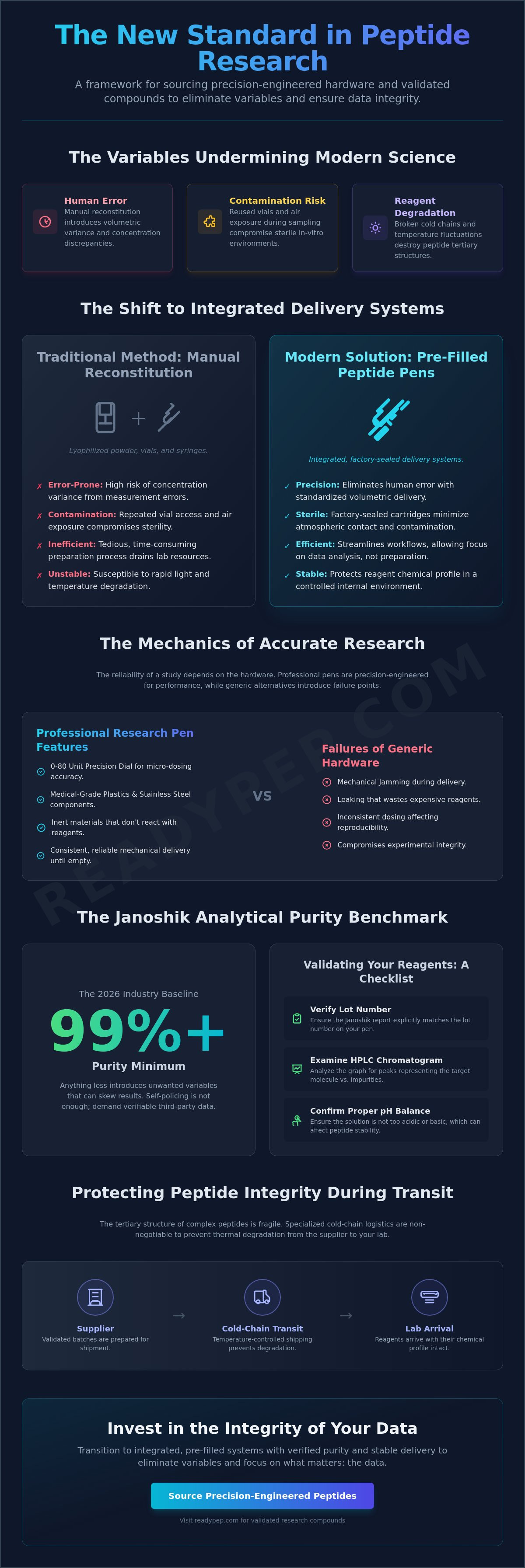
Modern in-vitro research demands a departure from the "good enough" methodologies of the past. For years, laboratories relied on lyophilized powder and glass vials. This required manual reconstitution. It was a tedious, error-prone necessity. Today, the industry is moving toward integrated systems. When labs choose to buy research peptide pens, they're selecting efficiency over tradition. This shift isn't just about convenience. It's about data integrity. Pre-filled systems eliminate the variability of manual preparation. They provide a standardized platform for reagent delivery. This ensures every trial begins with the exact same volumetric parameters. Standardized protocols are easier to enforce when the hardware does the heavy lifting.
Reagent stability is another critical factor. Traditional glass vials are susceptible to light and rapid temperature fluctuations every time a researcher draws a sample. Pre-filled cartridges offer a more stable internal environment. They're designed to maintain the chemical profile of the peptide from the first dose to the last. This consistency is vital for long-term studies where even minor degradation can skew the final analysis. Transitioning to integrated systems means fewer ruined batches and more reliable outcomes.
In-Vitro Precision: Why Reconstitution Variables Matter
Manual reconstitution is a significant source of concentration variance. A slight over-pull on a syringe or a minor measurement error changes the concentration of the entire batch. These discrepancies ripple through a study. They make it impossible to replicate results with high fidelity. Air exposure is another silent variable. Every time a vial is opened or a needle pierces a stopper, oxidation begins. This process can rapidly degrade the peptide's tertiary structure. Pre-filled cartridges prevent this. They're factory-sealed. They minimize atmospheric contact. By standardizing dosage increments, researchers can focus on the biological response rather than the math of the mix. It's about removing the human element where it isn't needed.
The Mechanics of Professional Research Pens
The reliability of a study depends on the hardware. A professional injector pen is a marvel of precision engineering. It features a 0-80 unit precision dial. This allows for extreme micro-dosing accuracy. Metatide Healthcare manufacturing has set the benchmark for these components. Their systems don't just work; they perform under pressure. Cheap, generic pens often suffer from mechanical failure. They jam during delivery. They leak. This wastes expensive reagents and compromises the experiment. High-quality research pens utilize medical-grade plastics and stainless steel. These materials are inert. They don't react with the peptide solution. They ensure the mechanical delivery remains consistent until the cartridge is empty. For labs that buy research peptide pens, these mechanical standards are the foundation of accurate research.
Evaluating Purity Standards: The Janoshik Analytical Benchmark
In-vitro research is only as good as the reagents used. When you buy research peptide pens, the burden of proof lies entirely with the supplier. Self-policing isn't enough in a professional laboratory setting. You need raw, verifiable data. Janoshik Analytical has become the industry benchmark for this verification. By April 2026, they were processing approximately 5,000 samples per month. This high volume reflects a market that finally values transparency over low-cost promises. A legitimate supplier doesn't just claim quality. They prove it with every lot.
Reading a Janoshik report requires a focus on more than just the final percentage. You must examine the HPLC (High-Performance Liquid Chromatography) chromatogram. This graph displays the "peaks" that represent the target molecule alongside any secondary substances. If the report doesn't explicitly match the lot number on your pen, the data is irrelevant to your current study. This level of scrutiny aligns with the FDA guidance on peptide purity, which emphasizes the necessity of detailed impurity profiling for synthetic peptides. Analytical standards aren't suggestions; they're the foundation of reproducible science.
Purity vs. Potency: What Researchers Must Look For
High-purity reagents are non-negotiable for modern assays. As of 2026, the industry baseline has shifted. 99% purity is the new minimum, replacing the old 98% standard. Anything less introduces unwanted variables that can skew your results. pH balancing is equally critical. If the solution is too acidic or basic, the peptide's structural integrity can collapse before the study is complete. Common impurities, such as residual solvents or trifluoroacetic acid (TFA) salts, can interfere with sensitive cellular assays. You need a reagent that is chemically clean and structurally sound.
Lot-Specific Traceability in Procurement
Batch testing is an outdated practice. It assumes every unit in a large production run is identical. It's a gamble that high-stakes research shouldn't take. You need lot-specific data to ensure the exact hardware in your hand has been verified. ReadyPep addresses this by integrating unique lot numbers with real-time analytical data for every shipment. For those who prioritize accuracy, you can access verified research tools that meet these rigorous procurement standards. Lot-specific documentation is the ultimate safeguard for lab reproducibility.
When you buy research peptide pens, you're buying the right to trust your data. Don't settle for manufacturer claims that haven't been cross-referenced by an independent third party. The cost of a failed experiment far outweighs the investment in verified reagents.
Pre-Filled vs. Reusable Hardware: A Procurement Comparison
Procurement decisions often hinge on a false economy. Labs looking to save budget might consider reusable hardware. They think DIY filling is cheaper. They're wrong. Reusable pens demand a sterile environment for transfer. They require specialized needles and syringes. Every transfer step increases the risk of contamination. It also guarantees reagent loss. When you buy research peptide pens that are pre-filled, you eliminate these variables. Factory-sealed cartridges arrive sterile. They stay sterile. This isn't just about convenience. It's about maintaining a controlled environment for your reagents.
The Hidden Costs of Marketplace Hardware
Marketplace hardware is a gamble. Pens sourced from Amazon or eBay frequently suffer from high mechanical failure rates. These unbranded devices lack technical support. They also create "V2 versus V3" compatibility confusion that stalls research. These versions often lack standardized threading. They create a compatibility nightmare for researchers trying to source replacement cartridges. High-stakes tirzepatide peptide studies cannot afford hardware malfunctions. A jammed dial or a leaking cartridge can invalidate weeks of data. Professional procurement requires hardware that is as reliable as the peptide itself.
The "V2 versus V3" hardware debate on public marketplaces is a distraction. Pre-filled systems bypass this friction. They provide a unified ecosystem where the hardware and the reagent are designed to work together perfectly. When you buy research peptide pens from a specialized provider, you're buying a validated system. You aren't just buying a plastic shell. You're buying the assurance that the mechanical delivery will be as precise as the chemical purity. This reduces the administrative burden of troubleshooting failed equipment.
Why Pre-Filled Pens are the "Gold Standard" for Labs
Efficiency is a measurable lab asset. Pre-filled pens reduce lab setup time by 40% compared to manual vial-to-pen transfers. This allows researchers to focus on analysis rather than assembly. You eliminate the need for extra supplies. No more sterile syringes. No more transfer needles. Every pen contains the exact concentration of reagents like Semax or SLU-PP-332. This accuracy is supported by Regulatory Guidelines for Therapeutic Peptides, which emphasize the importance of rigorous stability and quality control in synthetic compounds. For long-term projects, ordering peptide pen bundles ensures a consistent supply of validated hardware. It's the gold standard for modern in-vitro studies. It's how you scale without sacrificing precision.
Cold-Chain Logistics: Protecting Peptide Integrity During Transit
High-purity reagents are useless if they arrive denatured. When you buy research peptide pens, you're paying for molecular precision. That precision depends on temperature control. Peptides are essentially chains of amino acids held in specific 3D shapes. Heat breaks these bonds. This is called denaturation. Once a peptide loses its tertiary structure, its biological activity vanishes. It becomes inert. Standard courier services aren't designed for this level of sensitivity. They use ambient trucks. They leave packages on hot loading docks. This is why specialized logistics are non-negotiable for professional laboratories.
ReadyPep operates from a UK base. We utilize a worldwide shipping protocol designed specifically for biologicals. This includes insulated packaging and active cooling elements. We track every shipment from dispatch to delivery. This ensures the thermal integrity remains intact across borders. For researchers who need reliability, you can order temperature-controlled research pens directly from our validated inventory. Verifying the thermal integrity upon arrival is simple. Check the cooling packs. They should still be cool to the touch. If the internal temperature has spiked, the reagent's utility is compromised.
The Risks of Ambient Shipping for Research Reagents
Heat exposure is the primary cause of reagent failure. Denatured peptides often look identical to stable ones in a solution. You won't know they've failed until your assay produces zero results. Identifying signs of degradation is difficult but necessary. Look for cloudiness or precipitation in the cartridge. However, chemical degradation can occur even in clear solutions. This is why relying on ambient shipping is a gamble with your data. Standard couriers treat biologicals like consumer goods. They don't prioritize the cold chain. This leads to inconsistent data and wasted lab budgets.
Implementing a Cold-Chain Procurement Strategy
A rigorous procurement strategy removes uncertainty. Follow these steps to protect your reagents:
- Select a validated vendor: Only work with suppliers who use dedicated refrigerated logistics. Avoid marketplaces that ship via standard mail.
- Monitor transit times: Ensure your lab is ready to receive the shipment immediately. Customs clearance can be a bottleneck. Track your package to minimize time spent in non-refrigerated holding areas.
- Immediate storage: Establish a protocol for receipt. Pens must move from the shipping container to a calibrated laboratory refrigerator instantly.
When you buy research peptide pens, the cold chain is part of the product. It's not an optional add-on. It's a requirement for scientific accuracy. Don't let poor logistics invalidate your research.
Streamlining Lab Budgets with Peptide Pen Bundles
Efficiency in the lab isn't limited to the pipette or the pen. It extends to the balance sheet. Strategic procurement is the final step in a high-standard research workflow. When labs decide to buy research peptide pens, the move from individual units to bundles represents a significant shift in operational maturity. It's about securing a consistent supply of validated reagents. Bundles and stacks provide an economic advantage that unit-based purchasing cannot match. They lower the per-unit cost. They ensure every phase of a multi-month study utilizes the same batch-tested hardware. This eliminates the risk of supply chain interruptions mid-assay.
Customization is central to this strategy. Research goals are rarely generic. Metabolic studies might require specific stacks, while cognitive research demands different concentrations. ReadyPep prioritizes transparency in this process. Every bundle is backed by the same rigorous documentation discussed earlier. Pricing is direct. Verification is absolute. There's no marketing fluff. Just raw data and reliable supply. Standardizing your reagents shouldn't be a hurdle. It should be a baseline.
Optimizing Procurement for High-Volume Studies
High-volume studies require a clear understanding of ROI. The initial cost of pre-filled pens is offset by the massive reduction in labor hours. You aren't paying technicians to manually reconstitute and fill generic shells. You're paying for a ready-to-use system. Logistically, bundles offer a measurable reduction in packaging waste in large-scale environments. This streamlines lab storage. It also ensures peptide pen quality control remains uniform across the entire procurement cycle. Larger orders allow for more efficient batch verification. This reinforces the statistical power of your data.
Choosing Your Research Partner
Supply chain reliability is the backbone of successful research. ReadyPep’s direct relationship with Metatide Healthcare ensures a consistent, uninterrupted flow of precision hardware. We don't rely on third-party marketplace resellers. We control the source. This partnership allows us to offer free worldwide shipping on qualified laboratory orders. It removes the final friction point in global procurement. When you buy research peptide pens, you need a partner that values integrity over industry norms. It's time to secure your data by securing your supply.
Advancing In-Vitro Accuracy through Validated Procurement
The transition toward pre-filled systems is a commitment to scientific rigor. Modern laboratories no longer accept the variables of manual reconstitution or unverified reagents. By prioritizing lot-specific Janoshik Analytical testing and precision-engineered hardware, you secure the foundation of your research. This isn't just about efficiency. It's about ensuring every data point is rooted in chemical stability and volumetric accuracy. When you choose to buy research peptide pens, you're selecting a system designed for high-stakes analysis. Every peak on a chromatogram matters. Every micro-dose must be exact.
ReadyPep operates as an authorized Metatide Healthcare distributor to provide this level of clinical certainty. We combine radical transparency with sophisticated logistics to remove friction from your workflow. Every qualified order includes free worldwide cold-chain shipping. This preserves the tertiary structure of your compounds from our facility to your laboratory refrigerator. You deserve a procurement partner that values data integrity as much as you do. Accuracy is no longer a variable. It's a standard you can rely on for every study.
Browse Pre-Filled Research Peptide Pens and Bundles
Laboratory Procurement FAQs
Are these peptide pens intended for human or veterinary use?
No. These reagents are strictly for in-vitro laboratory research only. They are not for human or veterinary use. Any application outside of a controlled laboratory setting violates the legal and scientific framework for these compounds. Research Use Only (RUO) status ensures that these materials are handled according to rigorous analytical protocols. We don't provide instructions for any use beyond laboratory investigation.
How do I verify the purity of the peptides in the pens I buy?
You verify purity by reviewing the lot-specific Janoshik Analytical report provided with every shipment. This report includes an HPLC chromatogram showing the purity peaks and the chemical identity of the compound. When you buy research peptide pens, you must verify that the lot number on the hardware matches the analytical data. This ensures the reagent meets the 99% purity baseline required for modern science.
What is the shelf life of a pre-filled research peptide pen?
Pre-filled pens typically have a shelf life of 12 to 24 months when kept in a calibrated laboratory refrigerator at 2°C to 8°C. Stability depends on the specific peptide sequence and the buffer solution used. Once the cartridge seal is breached for transfer, the reagent's integrity begins to degrade. Maintaining a consistent cold chain is the only way to prevent molecular denaturation and preserve research utility.
Do the pens come with needles for in-vitro transfer?
No. Needles aren't included with the pens. This allows researchers to select the precise gauge and length required for their specific in-vitro transfer protocols. This policy also maintains the sterile integrity of the hardware during storage and transit. Most labs use standardized 31G needles to ensure accurate volumetric delivery into cellular assays without introducing air bubbles or contamination.
How does cold-chain shipping work for international laboratory orders?
International orders utilize insulated shipping containers and active cooling elements to maintain thermal stability. We track these shipments in real-time to ensure they stay within the required temperature range during transit. Our 2026 logistics framework is designed to move biologicals through customs efficiently while protecting the tertiary structure of the peptides. This prevents the heat-induced degradation common with standard courier services.
What is the difference between V1, V2, and V3 peptide pens?
V1, V2, and V3 are designations used by marketplace resellers to describe mechanical hardware iterations. These often cause compatibility issues with standard cartridges and lead to mechanical failure. ReadyPep utilizes standardized Metatide Healthcare hardware to eliminate this friction. Every cartridge fits every pen in our inventory. This ensures that the mechanical delivery is as precise as the chemical purity of the reagent.
Can I buy peptide pen bundles for different research reagents?
Yes. You can buy research peptide pens in customized bundles or stacks tailored to specific cognitive or metabolic research goals. Bundling reagents reduces the per-unit cost and streamlines the procurement process for high-volume longitudinal studies. It ensures a consistent supply of validated reagents for the duration of your project. Every bundle includes the same rigorous lot-specific documentation as individual units.
What happens if my shipment is delayed in customs?
Our logistics team proactively monitors every international shipment for customs bottlenecks. If a delay threatens the thermal stability of the reagents, we intervene to expedite the clearance process. We utilize advanced tracking to ensure the cold chain remains intact until the package reaches your lab. Protecting the integrity of the reagent is our primary concern during the entire transit period.
Disclaimer
Educational content only. Not medical advice.


