

Is the lowest research peptide pen price actually costing your lab its scientific credibility? You already know that inconsistent delivery volumes and reagent impurities don't just delay results; they invalidate months of precision work. Hidden shipping fees and questionable hardware often mask the true expense of a failed in-vitro study. It's a high-stakes risk that your budget and your reputation can't afford. High-impact research requires more than just a low ticket price; it demands empirical verification.
This 2026 buying guide provides an authoritative breakdown of the variables influencing research peptide pen price. We move beyond surface-level costs to establish a rigorous framework for evaluating reagent value in a market where 99% purity is the new minimum standard. You'll learn how to audit lot-specific purity documentation, evaluate the mechanical precision of pre-filled delivery systems, and eliminate procurement friction. We'll show you how to calculate the true cost of your reagents to ensure your laboratory operates with clinical precision and total transparency.
Key Takeaways
- Understand the distinction between empty hardware and pre-filled systems. Don't risk volumetric inaccuracies in sensitive trials.
- Evaluate the true research peptide pen price by calculating purity-adjusted costs. It's about data, not just the sticker price.
- Identify supplier red flags through a rigorous audit. Require third-party verification and lot-specific documentation for every reagent.
- Measure the total cost of ownership. Include lab labor costs and the friction of manual vial-to-pen transfers.
- Optimize your procurement workflow. See how pre-filled systems ensure reagent integrity and consistent scientific outcomes.
Decoding Research Peptide Pen Costs: Hardware vs. Pre-Filled Systems
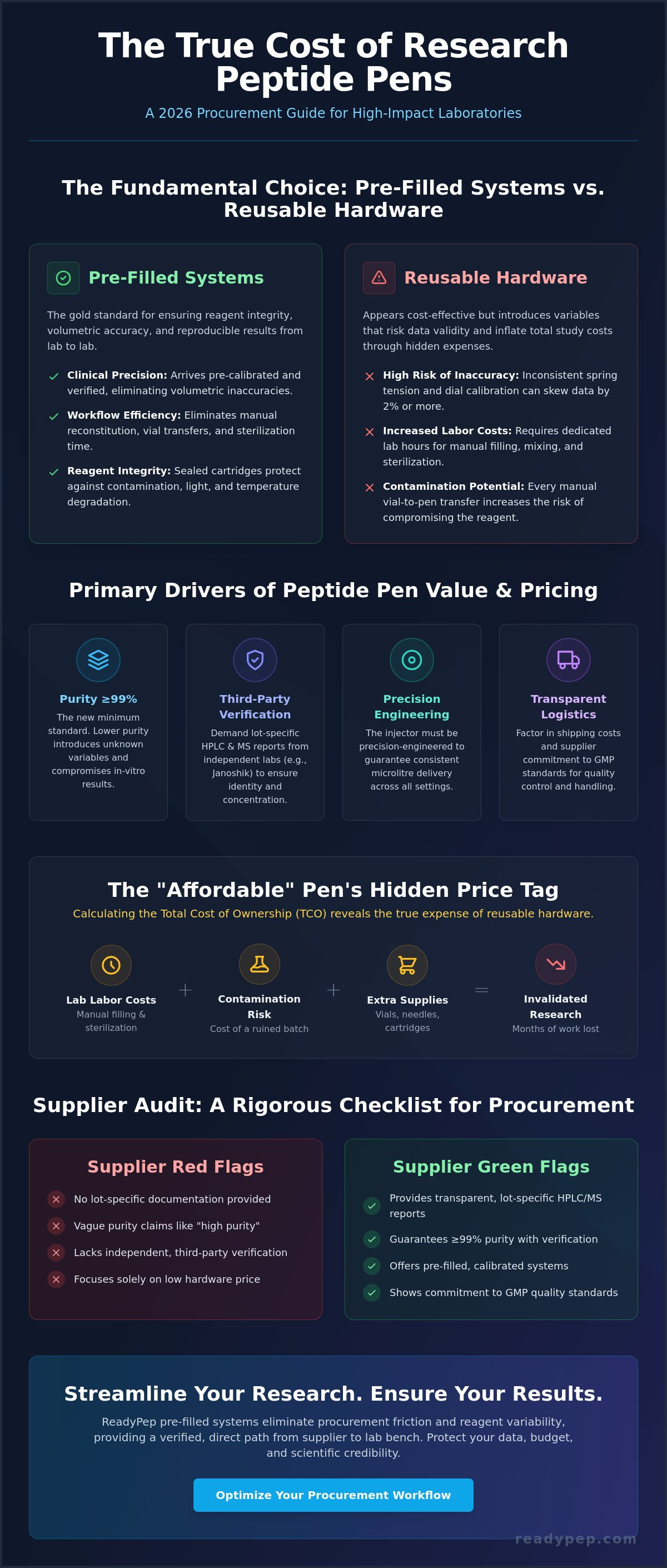
Procurement for in-vitro studies often begins with a fundamental misunderstanding of what constitutes a "peptide pen." Marketplaces are flooded with low-cost hardware, but the hardware is merely the delivery vehicle. To accurately assess the research peptide pen price, you must differentiate between the delivery device and the reagent it contains. Empty reusable pens, often priced between $20 and $50, represent a one-time hardware acquisition. However, the real laboratory investment lies in the validated reagents and the precision of the integrated delivery system. Choosing a pre-filled system eliminates the need for manual reconstitution and vial transfer, streamlining your workflow from the moment of arrival.
Producing high-purity reagents involves complex chemical peptide synthesis, where even minor variations in manufacturing can alter the molecular profile. When you purchase a pre-filled system, you aren't just buying a pen. You're buying a verified concentration that has been integrated into a calibrated injector. Cheap hardware is a liability. Inconsistent spring tension or poor dial calibration leads to volumetric inaccuracies. In sensitive in-vitro trials, a deviation of even 2% in delivery volume can skew data and invalidate months of work. Pre-filled laboratory systems eliminate this variable. They arrive pre-calculated and ready for immediate application.
The Components of a Professional Peptide Pen
A professional-grade system integrates three critical elements. First, precision-engineered injector hardware ensures consistent microlitre delivery across every dial setting. Second, the system contains high-purity peptide content, such as Metatide Healthcare reagents, which meet the rigorous ≥98% purity threshold. Finally, it utilizes independently verified cartridges designed for long-term stability. These cartridges protect the reagent from light degradation and temperature fluctuations, ensuring the integrity of your research material remains uncompromised.
Hidden Costs of Reusable Hardware
Reusable hardware appears cost-effective on paper, yet it introduces significant hidden expenses. You must purchase separate sterile cartridges, specialized needles, and prep pads for every study. Then there is the time factor. Manual filling and sterilization require dedicated laboratory hours that could be spent on data analysis. Most importantly, every manual transfer from a vial to a pen cartridge increases the risk of contamination. A single airborne contaminant can ruin a lot-specific reagent. This turns a "cheap" hardware purchase into an expensive failure. Pre-filled systems remove this friction, providing a clean, verified path from the supplier to the laboratory bench.
Primary Drivers of Peptide Pen Pricing: Purity, Verification, and Logistics
Evaluating the research peptide pen price requires looking past the invoice total. Scientific integrity depends on what happens before the product reaches the bench. A low price point often masks a lack of analytical verification. High-tier laboratories recognize that the cheapest option is usually the most expensive in the long run. If a reagent fails to produce reproducible data, the entire cost of the study is lost. Quality is not a variable you can compromise on in a clinical environment.
Pricing transparency starts with the disclosure of third-party testing. Verification from independent labs like Janoshik Analytical provides the empirical proof necessary for high-impact research. Beyond purity, pH testing is a non-negotiable requirement for research integrity. Reagents with incorrect acidity levels can lead to rapid degradation or altered molecular interactions. When you compare suppliers, you aren't just comparing hardware. You're comparing the depth of their documentation and their commitment to Good Manufacturing Practice (GMP) Standards within their quality control workflows.
Analytical Verification Costs
Third-party testing is the only way to confirm a reagent's identity and concentration. Lot-specific HPLC (High-Performance Liquid Chromatography) and Mass Spectrometry (MS) testing are essential for every batch produced. These tests identify impurities that could skew in-vitro results. Janoshik verification acts as a shield against under-dosed products. While these tests increase the initial procurement cost, they justify the premium by providing absolute certainty. Transparent documentation is the hallmark of a professional supplier. For labs prioritizing data over discounts, pre-filled research pens offer a streamlined path to verified results.
Cold-Chain Logistics and Stability
Logistics represent a significant portion of the final procurement price. Peptides are thermally sensitive. They require strict temperature-controlled environments during international transit to prevent molecular breakdown. Standard postal services are a false economy. They lack the monitoring systems needed to ensure stability. Cold-chain shipping utilizes specialized packaging and expedited routing to maintain reagent validity. This investment prevents peptide degradation. It ensures that the material arriving at your lab is identical to the material that left the manufacturer. Standard shipping might be cheaper, but it's a gamble that professional researchers don't take.
Finally, consider the unit economics of your purchase. The price-per-milligram often tells a different story than the price-per-unit. A pre-filled system might have a higher upfront cost, yet its purity-adjusted value is often superior. When you account for the elimination of labor and the reduction of contamination risks, the value proposition becomes clear. Efficiency is just as important as the reagent itself.
Comparative Analysis: Pre-Filled Pens vs. Reusable Hardware Bundles
Selecting a procurement strategy requires an honest assessment of the total cost of ownership (TCO). Many labs prioritize the initial research peptide pen price of reusable hardware bundles, assuming that manual assembly saves budget. This calculation is often incomplete. It ignores the cumulative expense of labor, consumables, and the statistical risk of volumetric variance. In high-throughput environments, the true price isn't found on the invoice; it's found in the efficiency of the workflow. Does the lower hardware cost justify the hours spent on manual preparation? For most professional settings, the answer is no.
The "DIY" Method: Vials + Reusable Pens
The "do-it-yourself" approach involves purchasing empty injector hardware and sourcing reagents separately in lyophilized vials. This requires recurring investments in bacteriostatic water, sterile cartridges, and transfer syringes. Beyond material costs, consider the time. Reconstitution and volumetric calibration consume valuable laboratory hours. Every manual transfer from a vial to a pen cartridge introduces a point of failure. You risk reagent loss through residual volume in the vial or accidental contamination during the transfer process. These micro-losses aggregate; they quietly inflate your operational budget while compromising data consistency. If a single lot is contaminated during transfer, the hardware savings disappear instantly.
The Pre-Filled Method: Direct Lab Integration
Pre-filled systems represent a shift toward direct lab integration. While the upfront unit cost is higher, the labor requirement for preparation is zero. These systems arrive pre-loaded and calibrated, providing guaranteed volumetric precision. This consistency reduces the margin of error in longitudinal studies. When evaluating specific reagents, researchers should consult established Tirzepatide standards for procurement benchmarks. These standards emphasize that purity and pre-filled accuracy are the primary drivers of research validity. Efficiency isn't just a convenience; it's a method of risk mitigation.
High-throughput labs require "ready-to-research" solutions. Standardizing delivery through pre-filled systems eliminates the variance inherent in manual filling. It allows your team to focus on analytical outcomes rather than logistical preparation. When you factor in the elimination of transfer risks and the preservation of reagent integrity, the value of a professional pre-filled system becomes undeniable. It's a strategic investment in precision that ensures your research peptide pen price reflects actual laboratory utility rather than just a hardware ticket.
Buying Guide: Evaluating Peptide Suppliers for Cost-Efficiency
Selecting a supplier is a risk-management exercise. In a market where "gray market" resellers often prioritize volume over verification, your procurement strategy must focus on accountability. A low research peptide pen price is a common bait for unverified reagents. High-standard laboratories look beyond the price tag. They prioritize manufacturer origin and verifiable quality controls. Metatide Healthcare standards serve as a benchmark for this level of precision. When you source from providers that adhere to these protocols, you eliminate the uncertainty that leads to failed in-vitro trials.
Red flags are often hidden in the fine print. Does the supplier omit shipping details? Do they provide generic, non-lot-specific data? If a deal seems too good to be true, it's likely because the reagent lacks the purity required for reproducible science. Impure peptides don't just skew data; they can permanently damage laboratory equipment or ruin months of longitudinal study. True cost-efficiency is found in reagents that perform exactly as documented. This is why professional researchers opt for pre-filled peptide bundles to ensure consistency across every unit.
Supplier Transparency Checklist
Before finalizing any purchase, run every potential supplier through this rigorous audit. Transparency is not an optional feature. It is a fundamental requirement for scientific integrity.
- Analytical Proof: Does the supplier provide lot-specific Janoshik reports for both purity and pH? Avoid any provider that offers only "typical" or "representative" COAs.
- Logistical Integrity: Is cold-chain shipping included in the quoted price, or is it added as a hidden fee during checkout? Standard postal delivery is a disqualifying factor for sensitive peptides.
- Manufacturing Standards: Are the products manufactured in a facility with verifiable quality controls? Verify that the provider can document their supply chain from synthesis to cartridge filling.
Maximizing Research ROI with Bundles
Strategic procurement helps optimize laboratory budgets without sacrificing quality. Peptide pen bundles are the most effective way to reduce the average cost per unit. For large-scale studies, consolidated procurement minimizes shipping overheads and ensures that all reagents come from the same verified batch. This lot-specific consistency is vital for multi-variable in-vitro analysis. Stacking reagents allows for more complex study designs while maintaining a streamlined procurement process. By purchasing in volume, you secure a more favorable research peptide pen price while locking in the stability of your reagent supply. Efficiency and precision should always move in tandem.
ReadyPep Solutions: Streamlining Procurement with Pre-Filled Pens
ReadyPep operates at the intersection of scientific rigor and logistical efficiency. We recognize that a competitive research peptide pen price is meaningless if the reagent fails at the bench. Our model eliminates the variables that compromise in-vitro data. By focusing exclusively on pre-filled systems, we remove the burden of reconstitution and the risk of cross-contamination. We provide a streamlined, professional alternative to the fragmented approach of sourcing hardware and vials separately. Every unit we distribute represents a commitment to radical transparency and empirical proof. Precision matters. Data is final. We deliver both.
Our role as a high-standard gatekeeper ensures that your laboratory receives only verified reagents. We don't rely on marketing hyperbole. We rely on data. This approach positions ReadyPep as a disruptor in a market often clouded by uncertainty. We prioritize accountability over industry norms. When you source from us, you're choosing a partner that values your research outcomes as much as you do. We've removed the friction of procurement so you can focus on the science of discovery.
The ReadyPep Standard
Our protocols are built on the synergy of Metatide manufacturing and Janoshik Analytical verification. We don't just claim purity; we document it. Every order includes lot-specific HPLC and MS reports. This ensures your lab maintains GLP compliance without the administrative overhead. We provide the technical depth required for high-impact studies. To understand the nuances of our verification process, review our Quality Control article. We prioritize in-vitro research integrity through uncompromising standards and radical transparency.
Global Sourcing and Reliability
Logistics shouldn't be a barrier to precision. As a UK-based authorized distributor, ReadyPep maintains full control over cold-chain integrity from our facility to your laboratory. We offer free cold-chain shipping on all orders to ensure your reagents arrive in peak condition. No hidden fees. No standard postal risks. We handle the complexities of international transit and temperature monitoring. This ensures the research peptide pen price you see is the final investment for a ready-to-use reagent. It's time to elevate your procurement standards. Efficiency is a choice. Precision is a requirement. Explore our pre-filled research peptide pens today and secure the integrity of your next study.
Securing Research Integrity Through Precision Procurement
Navigating the 2026 market requires moving past the hardware ticket price to evaluate the total purity-adjusted research peptide pen price. Scientific success depends on the total elimination of laboratory variables. By prioritizing pre-filled systems over manual vial transfers, you mitigate contamination risks and ensure absolute volumetric precision across every study. Reagent integrity is verified through lot-specific Janoshik reports and strict adherence to Metatide Healthcare manufacturing standards. These benchmarks aren't merely quality markers. They're the foundation of reproducible data and credible scientific outcomes.
ReadyPep provides the technical infrastructure needed for modern high-throughput in-vitro studies. We handle the complexities of global cold-chain logistics so your team can focus on analytical breakthroughs rather than procurement friction. Every unit we distribute is a commitment to radical transparency and empirical proof. Take the uncertainty out of your supply chain and secure the materials your research deserves. Efficiency is within reach. Precision is just a click away.
Order Validated Research Peptide Pens with Free Cold-Chain Shipping
Your work demands the clarity of verified reagents. Invest in the precision your laboratory deserves and move your research forward with confidence.
Frequently Asked Questions
What is the average research peptide pen price in 2026?
Market data from June 2026 shows reusable peptide pen hardware typically costs between $18.99 and $25.00 for the device alone. Pre-filled systems vary significantly based on the specific reagent and concentration. For example, BPC-157 pre-filled pens currently range from $25.51 to $74.15 depending on the supplier's verification standards. These figures reflect the hardware and reagent costs but exclude the value of laboratory labor and third-party testing.
Why are pre-filled peptide pens more expensive than vials?
Pre-filled systems command a premium because they eliminate manual reconstitution and volumetric calibration. Vials require additional consumables like bacteriostatic water, sterile cartridges, and transfer syringes. Pre-filled pens are calibrated for precise microlitre delivery during manufacturing. This reduces the margin of error in sensitive trials. You're paying for the removal of laboratory friction and the guarantee of volumetric accuracy.
Does the price of a peptide pen include third-party purity testing?
Purity testing is often the primary differentiator in the research peptide pen price. Professional suppliers include lot-specific HPLC and MS reports from independent labs like Janoshik within the unit cost. Budget-tier providers often omit these to reduce overhead. Purchasing unverified reagents risks study invalidation due to impurities or incorrect concentrations, making the "cheaper" option more expensive in the long run.
How does cold-chain shipping affect the overall procurement cost?
Cold-chain shipping adds a necessary expense to prevent thermal degradation during transit. Peptides are molecularly sensitive. Standard postal services lack the temperature monitoring required for stability. While expedited cold-chain routing increases the initial procurement cost, it ensures the material arrives at your bench with its molecular integrity intact. Standard shipping is a false economy for sensitive reagents.
Are reusable pens from Amazon or eBay suitable for professional research?
Retail platforms like Amazon and eBay are unsuitable for professional laboratory procurement. Hardware from these sources often lacks the spring tension and dial calibration required for consistent delivery. Professional in-vitro studies require verified, precision-engineered systems. Using uncalibrated hardware introduces unacceptable variance into your data and compromises your scientific credibility.
Can I save money by ordering peptide pen bundles?
Ordering peptide pen bundles is the most effective way to reduce the average cost per unit. Consolidated procurement minimizes shipping overheads and administrative labor. For large-scale studies, bundles ensure that all reagents come from the same verified batch. This lot-specific consistency is vital for maintaining research integrity across multi-variable trials while optimizing your laboratory budget.
What documentation should be included in the price of a research peptide?
Every professional procurement should include a Certificate of Analysis (COA). This documentation must feature lot-specific HPLC results for purity and Mass Spectrometry (MS) for identity confirmation. High-tier suppliers also include pH testing data. Transparent documentation is the only way to verify that a reagent meets the ≥98% purity threshold required for high-impact journal submissions.
How do I verify the purity of a peptide pen before purchase?
Verify purity by requesting a lot-specific report from an independent analytical laboratory before finalizing your order. Match the batch number on the report to the identifier on your research peptide pen price quote or product packaging. Reputable providers offer digital verification links to third-party portals. This radical transparency ensures the reagent is exactly what it claims to be before you begin your study.
Disclaimer
Educational content only. Not medical advice.


