

Thymosin alpha-1 is a 28-amino-acid peptide linked to T-cell production and function, natural killer cell activity, and cytokine balance. A Thymosin Alpha-1 research pen presents the compound in a research-only format; these immune mechanisms aren’t a promise of a specific outcome in people.
It’s easy to read descriptions of immune activity as evidence of a predictable effect. The distinction matters: biological mechanisms, observed effects, and established human treatment outcomes aren’t interchangeable. Understanding that difference helps put the peptide’s potential significance in context.
This article explains thymosin alpha-1’s molecular profile and how its reported immune activity relates to T cells and natural killer cells. It also covers what expected effects mean in a research context, why the product’s research-only status matters, and how a pre-filled pen fits into the wider category of research peptide formats.
Key Takeaways
- Understand how thymosin alpha-1 is associated with T-cell function, natural killer cell activity, and cytokine balance.
- Get familiar with its molecular profile, including its 28-amino-acid structure and identifying chemical details.
- Separate proposed immune mechanisms from expected effects; biological activity alone doesn’t establish a predictable result.
- Learn why research-only status matters when interpreting product descriptions and intended use.
- See how a pre-filled pen format fits into the discussion without mistaking convenience for evidence of therapeutic benefit.
T-cell and natural killer cell activity
Thymosin alpha-1 is associated with T-cell production and function, natural killer cell activity, and cytokine balance. These are related but distinct parts of immune activity. T cells participate in adaptive immune responses, while natural killer cells are a separate immune-cell population. Cytokines are signaling molecules that help coordinate cellular responses. In research discussions, these connections describe areas of interest, not a guaranteed effect in a person.
This distinction matters when interpreting claims about immune support. A change in T-cell activity does not mean every T-cell subtype responds in the same way, and an association with natural killer cell activity does not establish a particular clinical outcome. Researchers need to define the cell population, experimental conditions, and measured endpoint. A laboratory study of a cell response, for example, answers a narrower question than a study measuring infections or recovery in people.
Immune-activity statements alone do not establish a specific side-effect, risk, or contraindication profile. T-cell and natural killer cell mechanisms do not demonstrate safety, individual tolerance, or suitability for human use. Keep these questions separate from laboratory findings, and do not interpret descriptions of immune mechanisms as dosing or treatment recommendations.
Dendritic-cell research models offer another useful perspective. Dendritic cells process and present antigens, helping connect innate immune recognition with T-cell responses. A model may examine how these cells interact with T cells under defined laboratory conditions. Results depend on the cell source, preparation, and assay endpoint. These details help researchers determine whether an observed response concerns antigen presentation, T-cell activation, or another measured process.
When comparing findings, match each claim to its evidence type. A report on T-cell function, a natural killer cell assay, and a dendritic-cell model are not interchangeable: each examines a different part of the immune system. Distinguish a measured laboratory response from a patient outcome, such as fewer infections or faster recovery. Cell activity alone cannot establish the latter. To interpret a result precisely, identify the cell, model, and endpoint before drawing conclusions. This also prevents cytokine balance from becoming shorthand for a broad, predictable immune benefit. With a research-only peptide, careful interpretation is essential to understand what the data support and what they do not establish.
Chemical classification and molecular profile
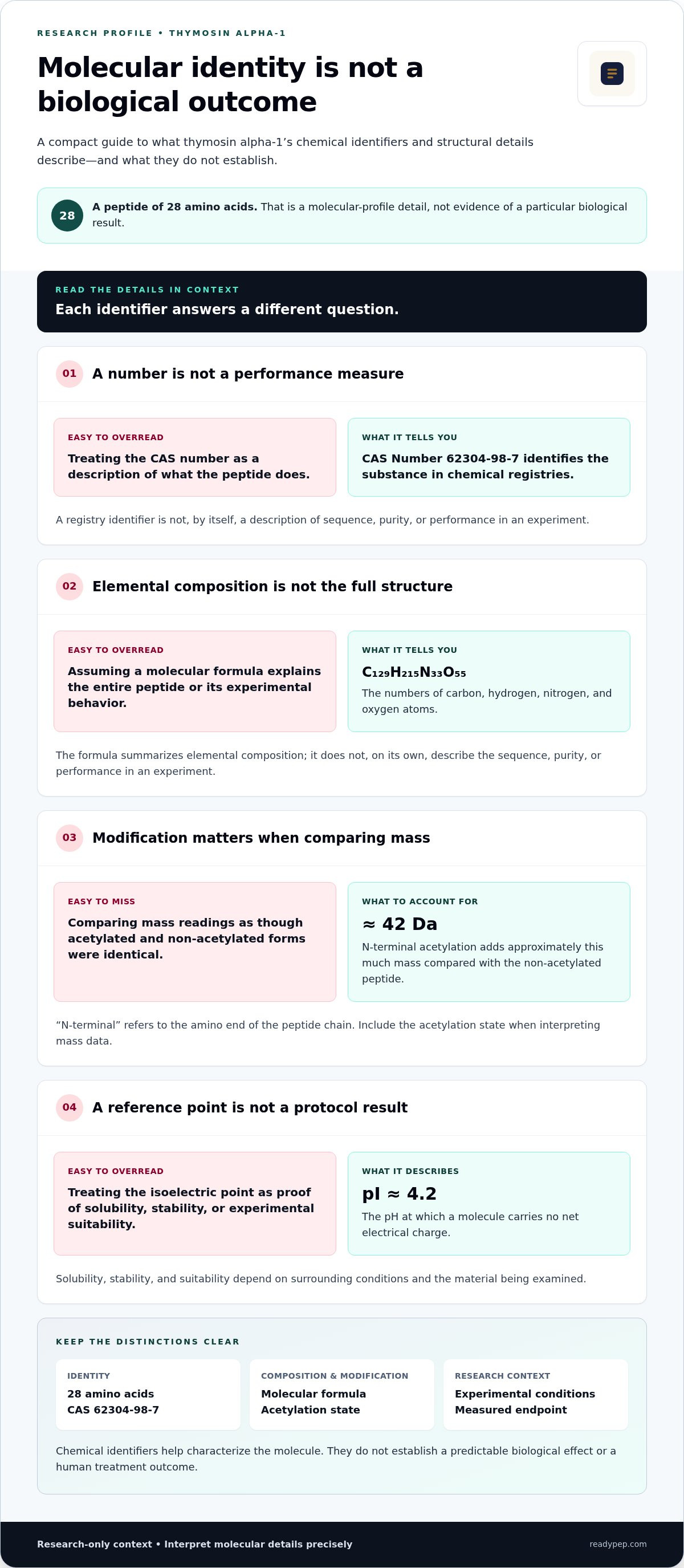
Thymosin alpha-1 is a peptide consisting of 28 amino acids. It is naturally produced by the thymus gland, which gives the molecule its name and biological context. A peptide’s amino-acid sequence and chemical modifications help distinguish its molecular identity. Here, the 28-residue length is a basic classification detail, not evidence of a particular biological outcome. Keeping structure separate from function helps make technical descriptions easier to interpret.
The compound is identified by CAS Number 62304-98-7. Its molecular formula is C₁₂₉H₂₁₅N₃₃O₅₅, which specifies the numbers of carbon, hydrogen, nitrogen, and oxygen atoms in the molecule. These identifiers serve different purposes: a CAS number distinguishes a chemical substance in registries, while a molecular formula summarizes elemental composition. Neither identifier alone describes the peptide’s sequence, purity, or performance in an experiment.
N-terminal acetylation is another relevant structural feature. Mass-spectrometric research shows that this modification adds approximately 42 Da compared with the non-acetylated peptide. The “N-terminal” label refers to the amino end of the peptide chain. Acetylation changes the molecule’s mass and may therefore matter when researchers compare molecular measurements. A comparison should distinguish the acetylated form from the non-acetylated form rather than treating their mass readings as identical.
Thymosin alpha-1 has an isoelectric point of about 4.2. The isoelectric point describes the pH at which a molecule carries no net electrical charge. This value gives researchers a chemical reference point when considering charge-related behavior under different conditions. It does not, by itself, establish solubility, stability, or suitability for a specific experimental protocol. Those properties depend on the surrounding conditions and the material being examined.
For careful identification, keep the key descriptors together: 28 amino acids, CAS Number 62304-98-7, molecular formula C₁₂₉H₂₁₅N₃₃O₅₅, and an isoelectric point of about 4.2. Add the acetylation state when interpreting mass data, since the reported difference is approximately 42 Da. This gives a clearer basis for comparing compound descriptions and considering formats in the research peptide catalog, without confusing identity, modification, and experimental effect.
Expected treatment results
Reports describe some patients noticing fewer infections and faster recovery within weeks to months of starting thymosin alpha-1 treatment. These are reported outcomes, not a fixed timeline for every person. The phrase “weeks to months” covers a broad observation window, not a precise point when a change should appear. It also doesn’t establish that thymosin alpha-1 caused each reported change. Interpretation depends on the outcome measured and the context in which it was observed.
“Fewer infections” and “faster recovery” refer to different outcomes. Infection frequency concerns how often infections occur over an observation period, while recovery time concerns the course of an individual illness. Evidence about one does not automatically answer the other. A report of fewer infections, for instance, does not show how quickly someone recovered from a particular infection. Keeping the endpoints distinct makes descriptions of expected effects more precise.
Timing also requires careful interpretation. A change observed within weeks may differ from one seen over months, since the observation periods are not equivalent. Identify when observation began, which outcome was tracked, and how it was assessed. Without those details, “improvement” can blur distinct ideas. Match each result to its stated endpoint, such as infection frequency or recovery time, rather than treating the terms as interchangeable.
Context matters, too. A reported effect in patients differs from a measurement in a laboratory model. The former describes an observed human outcome; the latter describes a response under experimental conditions. Neither should be substituted for the other. T-cell and natural killer cell activity concern mechanisms of immune response, but those mechanisms alone do not establish fewer infections or faster recovery. Interpret each result in light of the specific evidence and endpoint described.
For research-only products, distinguish a proposed or observed effect from an established treatment expectation. ReadyPep product listings identify these materials as intended solely for in-vitro laboratory research. That boundary matters when reading claims about patient outcomes: research descriptions are not instructions for human use. A clear summary preserves the reported timeframe, the stated outcomes, and the limits of what the observations establish. This helps readers assess claims without turning a broad report into a personal prediction or treatment recommendation.
Immune-system modulation
Compared with other immune-modulating peptides, thymosin alpha-1 is discussed through T-cell and natural killer cell activity, alongside cytokine balance. A useful comparison focuses on the mechanism studied, the model used, and the endpoint measured, rather than assuming peptides have interchangeable effects. Those criteria help separate a molecule’s research profile from broad claims about “boosting” immunity.
Immune modulation describes changes in the regulation of immune processes; it does not simply mean increasing every response. T cells and natural killer cells have distinct roles, while cytokines signal between cells. A research question about one pathway therefore differs from a question about overall immune function. A study examining T-cell activity, for example, cannot by itself establish an effect on infection frequency.
This distinction also matters when assessing claims about balance. Cytokine balance is not a single measurement or a universal outcome. Researchers need to specify which cytokines they assess, the cell types involved, and the model conditions. A finding about one signaling molecule cannot represent all cytokine activity. Naming the measured endpoint makes results easier to interpret and compare with other experiments.
Age is sometimes raised in discussions of immune defenses. Adults over 40 are identified as a group that may find thymosin alpha-1 helpful for maintaining immune defenses. This is a broad description, not a tailored result or a basis for predicting an individual response. Age alone does not explain which immune pathway is measured. In a research context, the model and its defined endpoint remain central.
A careful comparison with another peptide starts with the evidence, not the label “immune-modulating.” Check whether the research concerns T cells, natural killer cells, cytokine signaling, or another process. Then distinguish laboratory observations from reported patient outcomes. These evidence types answer different questions: an assay showing a cellular response, for example, cannot establish that people experience fewer infections. Keeping the levels separate prevents a mechanism from being mistaken for a treatment result.
When assessing immune-modulation claims, note three things: the peptide studied, the immune component measured, and the type of evidence reported. Compare like with like. A T-cell endpoint should be compared with another T-cell endpoint, not a general claim about immune health. This framework keeps research descriptions specific and avoids turning a proposed mechanism into a promise of clinical benefit.
Research-only use and product availability
“Research-only” defines the intended context, not a treatment recommendation. A product listing may label thymosin alpha-1 for in-vitro laboratory research use only. In-vitro work examines material outside a living organism, such as in a controlled cell model. That boundary matters: a research description does not establish suitability, safety, or effectiveness for human use. A pen format does not change that intended-use distinction.
How much do thymosin alpha-1 research pens cost in the United States? There’s no single U.S. price that can be applied across listings; quoted amounts depend on the product format, stated concentration, and included documentation. Compare the exact item and terms rather than assuming that similarly named listings describe equivalent products.
To assess purity and testing, match each claim to its evidence. Product descriptions report purity of at least 99% by HPLC, while a listing also states 99.5% purity. Treat those as separate reported figures, and look for the assay method, batch identifier, and corresponding Certificate of Analysis. A concentration describes the amount of peptide stated for the product; it doesn’t establish purity. Batch-linked documentation helps connect a test result to the material described.
Availability depends on the specific listing and its delivery terms. Some listings identify a 10 mg research product, but that quantity alone doesn’t establish the pen’s concentration, shipment destination, or suitability for a particular laboratory. Read the product description for the named format, stated amount, intended use, and testing details. For research planning, those particulars matter more than broad claims about immune activity.
What should someone do if considering thymosin alpha-1 personally? Don’t use a research-only product as a treatment; discuss the question with a healthcare professional. Ask about the intended use, relevant evidence, personal health history, other medicines, possible risks, and established alternatives. Those questions address clinical decision-making, which an in-vitro product description cannot resolve.
Keep the takeaway precise: research labeling, purity, concentration, and availability answer different questions. Verify that an HPLC claim and its Certificate of Analysis refer to the same batch, and distinguish laboratory use from human treatment. Readers comparing formats can review research peptide options alongside each product’s stated use and testing details.
Delivery is only within the UK, and the page says the product is for qualified researchers aged 21 or older.
ReadyPep: Retatrutide 20mg
ReadyPep offers Retatrutide 20mg as a separate research peptide option, not as a substitute for thymosin alpha-1. If your interest has shifted from immune-modulation research to comparing other compounds, this is a clear next point of reference. ReadyPep also offers Retatrutide 40mg, MOTS-c 40mg, and BPC-157 + TB-500 40mg.
Keep the research question specific: each compound has its own profile, and one product’s description does not establish another’s purpose or effects. Retatrutide is a distinct option in ReadyPep’s research peptide range. Review its product information in the context of research-only use, not as guidance for personal treatment.
To explore ReadyPep’s research peptide options, visit the ReadyPep website.
Make your next research step deliberate
A useful next step is to turn your interest in the Thymosin Alpha-1 research pen into a focused research question. Define what you want to examine, which evidence would answer it, and how you’ll distinguish laboratory observations from claims about human outcomes. That structure helps keep compound selection aligned with the purpose of your work.
For research-only materials, keep intended use at the center of the decision. Product format is one consideration; the research objective and the information needed to evaluate the material matter just as much. If you’re exploring other areas, ReadyPep’s research peptide range includes options beyond thymosin alpha-1.
Ready to discuss your research questions? Contact ReadyPep with your research questions and take the next step at your own pace.
Frequently Asked Questions
How Does It Support Immunity?
Research descriptions associate thymosin alpha-1 with several immune processes, rather than a single general “boost.” These include T-cell activity, natural killer cell activity, and cytokine signaling. Each concerns a different part of immune response, so a finding about one process doesn’t establish an effect on the others. For instance, a laboratory measure of cell activity cannot alone demonstrate protection from infection or improved recovery.
How Is It Administered?
Thymosin alpha-1 is commonly described in research protocols as administered by subcutaneous injection. That description isn’t an instruction for personal use. Route and procedure depend on the specific study protocol, and a research-only product isn’t a substitute for prescribed treatment. In a laboratory context, follow the approved experimental protocol and institutional requirements rather than adapting a research product description for human use.
What Is Thymosin Alpha-1?
Thymosin alpha-1 is a peptide associated with the thymus and studied for its relationship to immune activity. Its name refers to its thymic origin, while its peptide classification describes its molecular nature. It’s distinct from a complete immune system or a general-purpose immune stimulant. To understand a particular claim, identify the immune process examined and whether the evidence comes from a laboratory model or human observations.
What is thymosin alpha-1 and what does research say about its effects?
Thymosin alpha-1 is studied in relation to immune-cell function and signaling. Research descriptions discuss T cells, natural killer cells, and cytokines, while reports also describe patient outcomes such as infection frequency and recovery. These evidence types answer different questions. A cellular finding doesn’t establish a clinical result, and an observed patient outcome doesn’t by itself explain the mechanism. Read each claim alongside its measured endpoint and study context.
Is thymosin alpha-1 approved by the FDA in the United States, and for which uses?
ReadyPep identifies its peptide pens as intended solely for in-vitro laboratory research, not for human or veterinary treatment. A research product listing is not evidence of approval for therapeutic use. Regulatory status depends on the specific product and intended use, so distinguish the seller’s research-use designation from any claim that a product is authorized to diagnose, treat, or prevent disease.
What is a thymosin alpha-1 research pen, and how does it differ from a prescription product?
A Thymosin Alpha-1 research pen is a pre-filled format offered for laboratory research, while a prescription product is intended for use under an authorized medical framework. The formats may look similar, but intended use and oversight are different. ReadyPep’s research pens are not represented as prescription medicines or as suitable for human use. Packaging convenience doesn’t change that distinction or establish therapeutic safety.
What thymosin alpha-1 doses and injection schedules have been studied in clinical trials?
Protocol descriptions may mention subcutaneous administration two to three times weekly, but that figure is not a universal clinical-trial schedule or dosing recommendation. A trial’s regimen depends on its protocol and research question. Do not infer an amount or schedule from a product format. For accurate interpretation, distinguish a study’s stated regimen from general product descriptions, and never use research information as personal treatment guidance.
What are the legal rules for selling or importing thymosin alpha-1 for research use in the United States?
A “research use” label alone does not establish that a sale or import complies with U.S. requirements. Applicable obligations may depend on the product’s classification, labeling, intended use, and import circumstances. An overseas product listing is not proof of U.S. authorization. Before proceeding with a transaction, establish the product’s regulatory status and applicable import requirements with qualified U.S. regulatory counsel.
Disclaimer
Educational content only. Not medical advice.


