

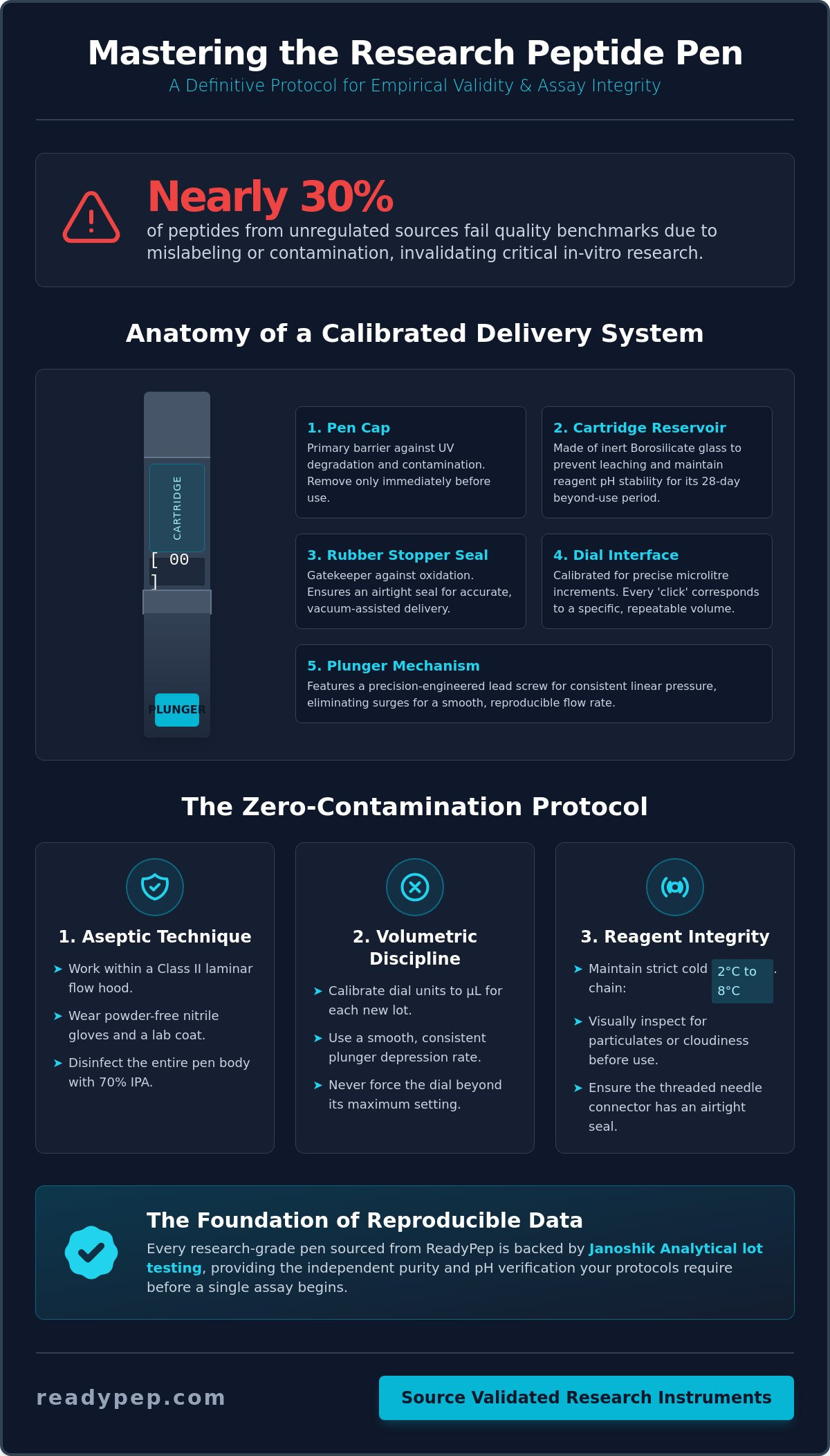
Did you know that nearly 30% of peptides from unregulated sources fail quality benchmarks due to mislabeling or contamination? In a high-stakes in-vitro environment, your results are only as reliable as your reagent integrity. Proper handling pre-filled peptide pens is no longer optional. It's a technical requirement for empirical validity. You understand that even a minor lapse in aseptic technique or a slight volumetric deviation can invalidate weeks of laboratory work.
Maintaining a strict cold chain between 2°C and 8°C while ensuring ISO 11608 volumetric accuracy is a complex balancing act. We'll help you eliminate friction in your workflow by mastering the technical requirements for purity and precision. This guide provides a definitive protocol for managing research-grade instruments; we cover everything from initial unboxing to lot-specific documentation. By standardizing these steps, you secure the integrity of compounds like Retatrutide or MOTS-c. ReadyPep provides the calibrated tools necessary to achieve zero contamination incidents and successful assay execution every time.
Key Takeaways
- Handling pre-filled peptide pens correctly requires a standardized protocol covering sterility, volumetric accuracy, and cold chain integrity — a single lapse in any one area can compromise your entire assay.
- Borosilicate glass cartridge integrity and proper pen cap management are non-negotiable checkpoints; understanding the anatomy of your delivery system is the first line of defense against reagent degradation.
- Aseptic technique in a laminar flow hood combined with 70% IPA surface disinfection establishes the contamination-free baseline your in-vitro research demands.
- Consistent plunger depression rate and precise dial calibration are what separate reproducible data from unreliable results — volumetric discipline is a technical skill, not an afterthought.
- Every research-grade pen sourced from ReadyPep is backed by Janoshik Analytical lot testing, giving you the independent purity and pH verification your protocols require before a single assay begins.
Anatomy of a Pre-Filled Research Peptide Pen
Precision in the lab starts with the instrument in your hand. A pre-filled peptide pen isn't just a container; it's a calibrated delivery system designed to meet ISO 11608 standards for dose accuracy and reliability. When handling pre-filled peptide pens, researchers must treat every component as a variable that influences the final assay result. Mastery of this hardware is the difference between empirical success and wasted reagents.
The pen cap serves as a critical primary barrier. It protects light-sensitive peptides like GHK-Cu or NAD+ from UV-induced degradation and maintains the sterility of the needle interface. Removing it should only occur immediately before reagent expulsion to minimize exposure. Below the cap lies the cartridge reservoir. High-quality borosilicate glass is used here because it's chemically inert. This prevents leaching and ensures the reagent's pH remains stable during the 28-day beyond-use period defined by USP <797> guidelines for multi-dose systems. Visualizing the reagent through this clear glass allows for instant verification of purity before the experiment begins.
Internal mechanics determine the success of your volumetric delivery. A robust Anatomy of an Injector Pen relies on a precision-engineered lead screw within the plunger mechanism. This screw applies consistent linear pressure. It eliminates the "surge" common with manual syringes, ensuring a smooth flow rate. Every mechanical "click" of the dose selector corresponds to a specific microlitre increment. This allows for extreme precision when preparing in-vitro concentrations. It's a level of control that manual pipetting often struggles to replicate in high-throughput settings.
Mechanical Components and Reagent Interaction
The rubber stopper seal is the gatekeeper against oxidation. A degraded or compromised seal allows atmospheric oxygen to enter the cartridge, potentially compromising sensitive peptide chains like MOTS-c or BPC-157. Always verify the threaded needle connector is free of debris. An airtight seal is mandatory for maintaining the vacuum required for accurate delivery. Before use, perform a quick visual inspection. The solution must be clear and free of floaters. Particulates or cloudiness are immediate indicators of reagent degradation or cold-chain failure.
The Role of the Dial Interface
Understanding the dial is vital for protocol success. In a research context, you must differentiate between the units shown on the interface and the actual volume in microlitres. Calibration is required for every new lot to ensure your math matches the output. Don't force the dial beyond its maximum setting. Over-dialing stresses the internal gears and can lead to mechanical failure or inaccurate dosing. Precise handling pre-filled peptide pens involves smooth, deliberate adjustments. This ensures the longevity of your hardware and the accuracy of your data. For researchers demanding verified purity and mechanical reliability, the ReadyPep product catalog offers delivery systems calibrated for the most demanding laboratory environments.
Sterility Protocols for Handling Pens in Lab Environments
While consumer-grade instructions focus on basic hygiene, handling pre-filled peptide pens in a research setting demands a rigorous aseptic checklist. Contamination in an in-vitro assay doesn't just ruin a sample; it compromises data integrity across an entire study. Maintaining a sterile field is the baseline for any credible laboratory protocol. This process begins long before the first reagent is dispensed.
Aseptic technique starts with the workspace. All preparations should occur within a Class II laminar flow hood or a similarly controlled sterile environment. Wear powder-free nitrile gloves and a dedicated lab coat to minimize particulate shedding. Before introducing the instrument into the hood, perform a thorough surface disinfection. Use 70% Isopropyl Alcohol (IPA) to wipe the entire pen body, focusing specifically on the dial interface and the rubber seal. Don't soak the pen. A deliberate wipe-down is sufficient to neutralize surface-level pathogens without compromising the internal mechanics.
Preparation of the Sterile Field
Managing the pen cap is a common point of failure. Remove it only once the pen is inside the sterile field. Place the cap on a fresh, lint-free sterile wipe to prevent cross-contamination. For researchers handling concentrated compounds like Retatrutide 40mg, maintaining this barrier is vital for preventing oxidation. Environmental controls are equally critical. Minimize the time the pen spends outside of its 2°C to 8°C storage environment. Every minute at room temperature increases the risk of reagent degradation, especially for sensitive peptide chains.
Needle Attachment and Priming
Needle management requires absolute discipline. Use only ISO-compliant, single-use sterile needle tips for every assay iteration. Reusing a needle, even within the same experimental batch, introduces unacceptable risks of microbial ingress. When attaching the needle, use the "Straight-On" method. Align the needle hub perfectly with the threaded connector. Angling the needle can tear the rubber seal, leading to leaks or air contamination.
Priming the system is the final step before execution. Dial a small increment, usually 1 or 2 units, and depress the plunger until a "safety drop" appears at the needle tip. This action removes trapped air bubbles that would otherwise displace reagent and cause volumetric errors. Verifying this fluid path patency confirms the system is ready for precise delivery. By standardizing these handling pre-filled peptide pens protocols, you ensure that your laboratory results are a product of the compound's efficacy, not handling inconsistencies. For high-throughput environments, sourcing validated delivery systems from ReadyPep provides the reliability needed to maintain these high standards.
Volumetric Accuracy: Using a Reusable Injection Pen for Assays
In-vitro research demands a level of precision that manual pipetting often fails to deliver. Correctly handling pre-filled peptide pens transforms a delivery device into a calibrated laboratory instrument. While clinical users focus on convenience, researchers must prioritize volumetric accuracy to ensure every assay iteration is statistically significant. This demands a technical understanding of the relationship between mechanical dial increments and microlitre output. Precision isn't just about the dial setting; it's about the physics of the delivery.
Consistent pressure is the cornerstone of accurate reagent expulsion. Jerky plunger depression causes internal turbulence and inconsistent volumes. Maintain a steady, controlled rate. This ensures the internal lead screw drives the stopper with uniform force. After the plunger reaches the zero mark, the process isn't finished. A post-delivery hold time of at least 10 seconds is mandatory. This allows the pressure to equalize and ensures the final droplet leaves the needle tip. Without this pause, you risk losing a fraction of your calculated concentration. This is a variable that can skew results for sensitive compounds like Retatrutide 20mg. Accuracy is non-negotiable.
Step-by-Step Delivery Protocol
Begin by calculating the exact units required based on the lot-specific concentration. Cross-reference the dial setting with your experimental design. When transferring the reagent to a target medium or a glass vial for analysis, insert the needle at a strict 90-degree angle. This prevents surface tension issues at the needle tip. Depress the plunger fully until it stops. Hold the position for 10 seconds. This protocol ensures complete volumetric transfer. Every step must be documented. Record the lot number, delivery volume, and the specific pen used. Precise documentation is the only path to reproducibility.
Troubleshooting Volumetric Deviations
Air bubbles are the primary enemy of accuracy. Even a small bubble in the cartridge reservoir can displace several microlitres of reagent. If bubbles appear, tap the cartridge gently and re-prime the system. Needle blockages are another common hurdle. If you encounter unexpected resistance, don't force the plunger. Forcing the mechanism can damage the internal gears. Replace the needle and verify patency with a safety drop. Mechanical resistance in the dial interface often indicates the reusable pen has reached its mechanical lifespan. When precision is the priority, researchers rely on the verified analytical standards provided by ReadyPep to ensure their equipment and reagents meet the highest benchmarks.
Cold Chain Maintenance and Peptide Integrity
Peptide stability is a delicate equilibrium. Once reconstituted, these compounds become highly susceptible to thermal degradation and secondary structure collapse. Precision requires cold-chain discipline. Professional handling pre-filled peptide pens involves more than just a standard refrigerator. It requires a documented environment where the temperature never deviates from the 2°C to 8°C range. Fluctuations outside this narrow window can lead to peptide denaturation, rendering your assay results statistically irrelevant.
Light sensitivity is another critical variable often overlooked in generic protocols. Many research peptides, such as GHK-Cu, are photosensitive and degrade rapidly when exposed to UV or ambient laboratory lighting. This is why the pen must remain in its original opaque packaging until the moment of use. Furthermore, the "In-Use" window begins the second the first seal is punctured. Following USP <797> standards, multi-dose reagents should be used within a 28-day beyond-use date when refrigerated. Tracking this window is essential for maintaining the empirical validity of your research.
Storage and Temperature Monitoring
Utilize calibrated laboratory refrigerators equipped with 24/7 digital temperature logging. Standard consumer units are insufficient; they lack the thermal stability required for sensitive reagents like Retatrutide. Never store pens in the freezer. Ice crystal formation causes mechanical stress on the peptide chains, leading to irreversible denaturation. When moving pens between storage and the laminar flow hood, use insulated carriers to minimize thermal shock. This level of care preserves the chemical potency you expect from high-tier reagents.
Integrity Verification via Documentation
Analytical transparency is the foundation of modern research. You should always cross-reference your pen lot numbers with Janoshik Analytical reports to confirm initial purity and pH levels. Monitoring pH serves as a reliable proxy for stability. A significant shift often indicates microbial growth or chemical breakdown. Implement a strict "First-In, First-Out" (FIFO) inventory system to ensure no reagent exceeds its stability window. By sourcing from ReadyPep, you gain access to compounds that have undergone rigorous third-party verification, ensuring your cold chain starts with a validated baseline of 99% purity.
Sourcing Validated Research Pens from ReadyPep
Successful in-vitro research is built on the foundation of reagent integrity. Even the most meticulous protocol for handling pre-filled peptide pens cannot compensate for a sub-standard compound. Independent analysis shows that approximately 30% of gray-market peptides suffer from mislabeling or contamination. This reality makes your sourcing decision as critical as your laboratory technique. ReadyPep eliminates this uncertainty by providing delivery systems that bridge the gap between unregulated sources and pharmaceutical-grade precision. Data integrity starts at the point of origin.
The Metatide Healthcare advantage lies in the precision manufacturing of every pre-filled delivery system. These instruments aren't just containers; they're engineered to meet ISO 11608 standards for volumetric accuracy. Every lot undergoes independent verification by Janoshik Analytical to confirm purity levels exceed 99%. When you're handling pre-filled peptide pens in a high-stakes environment, having a Certificate of Analysis (COA) for your specific lot number isn't a luxury. It's a requirement for empirical verification. From our UK base, we manage global cold-chain logistics to ensure that compounds like MOTS-c or BPC-157 arrive at your facility without thermal degradation.
The ReadyPep Commitment to Transparency
Transparency isn't a marketing buzzword; it's our operational standard. We provide lot-specific documentation for every research pen purchased. This allows you to verify the pH and purity of your specific reagent before it ever enters your laminar flow hood. You can gain direct access to COAs and analytical data through our centralized database. By maintaining a strict "Research Only" focus, we ensure that our products meet the rigorous standards demanded by modern laboratories. For complex, multi-variable studies, researchers often utilize the Edge Protocol to streamline their experimental stacks.
Procurement Strategies for High-Volume Labs
Efficiency is the hallmark of a modern lab. High-volume environments are increasingly moving away from traditional vial-and-syringe methods in favor of pre-filled formats. Sourcing items like GLP3-RT 20mg significantly reduces the time spent on manual reconstitution and volumetric calibration. The economic efficiency of pen delivery systems is clear; you reduce reagent waste and minimize the risk of human error during preparation. Data doesn't lie. Precision delivery leads to cleaner data and more reproducible results. You can secure your laboratory reagents by ordering validated peptide pens here to ensure your next assay is backed by the highest analytical standards in the industry.
Standardizing Precision for Empirical Success
Standardizing your laboratory protocols ensures that your experimental data remains beyond reproach. Mastery of the mechanical interface and strict adherence to aseptic techniques are the only ways to eliminate variables that compromise in-vitro results. By prioritizing cold-chain integrity and volumetric accuracy, you transform a simple delivery tool into a high-precision instrument. Correct handling pre-filled peptide pens is the technical baseline for any high-throughput research environment. It's about moving from uncertainty to empirical confidence with every microlitre dispensed.
ReadyPep facilitates this transition to professional-grade standards. Every lot we provide is backed by independent Janoshik Analytical testing for purity and pH verification. Our delivery systems are manufactured by Metatide Healthcare to ensure clinical precision. We remove the friction of international logistics with free worldwide cold-chain shipping; we deliver reagents that are ready for immediate assay integration. Secure your next study with instruments designed for radical transparency and verified quality. Browse the full range of validated research peptide pens at ReadyPep and elevate your laboratory standards today. Your pursuit of precision deserves reagents that are as disciplined as your protocols.
Frequently Asked Questions
Can I reuse the same needle for multiple assay deliveries?
No, you must never reuse a needle for multiple assay deliveries. Every puncture introduces the risk of microbial ingress and mechanical damage to the cartridge's rubber seal. Using a fresh, sterile needle for every iteration is the only way to maintain the aseptic standards required for handling pre-filled peptide pens. This discipline prevents cross-contamination between samples and ensures the mechanical integrity of the delivery system remains uncompromised throughout the study.
How long is a pre-filled research pen stable after the first use?
A pre-filled research pen remains stable for 28 days after the first seal puncture. This beyond-use date follows USP <797> standards for multi-dose containers, provided the pen is stored consistently between 2°C and 8°C. Stability decreases rapidly if the cold chain is interrupted or if the reagent is exposed to UV light. Always document the date of first use on the pen's opaque packaging to ensure you don't exceed this stability window.
What happens if the peptide reagent appears cloudy or discoloured?
If the reagent appears cloudy, discoloured, or contains visible particulates, you must discard the pen immediately. These visual cues are primary indicators of peptide denaturation, microbial contamination, or a significant shift in pH. Using compromised reagents will invalidate your assay results and produce unreliable data. Professional handling pre-filled peptide pens requires a visual inspection before every use to verify that the solution is perfectly clear and colorless.
Is it necessary to prime the pen before every single delivery?
Yes, you must prime the pen before the first delivery of every session to ensure volumetric accuracy. Priming removes air trapped in the needle hub and ensures the fluid path is fully patent. Failing to perform this "safety drop" can result in air bubbles displacing the reagent, which leads to significant volumetric errors in your assay. Consistent priming is a technical requirement for maintaining the ISO 11608 standards of accuracy expected in a controlled laboratory environment.
How can I verify the purity of the peptide inside my ReadyPep pen?
You can verify the purity of your peptide by cross-referencing the lot number on the pen with the independent reports on the ReadyPep website. Every batch undergoes comprehensive testing by Janoshik Analytical to confirm identity, purity, and concentration. These third-party reports provide the empirical verification necessary for lot-specific documentation. This radical transparency ensures that your in-vitro studies begin with a validated baseline of 99% purity.
What is the most accurate way to dial a very small dose for an in-vitro study?
The most accurate way to dial a small dose is to use the mechanical click increments while cross-referencing the lot-specific concentration. Each click corresponds to a precise microlitre volume. To ensure complete transfer, insert the needle at a 90-degree angle and maintain plunger pressure for at least 10 seconds after the dial returns to zero. This protocol accounts for pressure equalization and ensures the full calculated volume enters your target medium.
Can pre-filled research pens be shipped internationally without losing potency?
Pre-filled research pens can be shipped internationally without losing potency when managed through a dedicated cold-chain logistics network. ReadyPep utilizes temperature-controlled packaging to maintain the required 2°C to 8°C environment during transit. While lyophilized powders are more resilient at ambient temperatures, pre-filled liquid formats require this continuous thermal protection to prevent the secondary structure collapse of sensitive peptide chains like Retatrutide or MOTS-c.
How does Janoshik Analytical verify the pH of the peptide solution?
Janoshik Analytical verifies the pH of the peptide solution using calibrated potentiometric probes during the full analytical panel. Monitoring the pH is essential because it acts as a proxy for the stability of the peptide in its aqueous environment. A pH outside of the target range can indicate chemical breakdown or the presence of impurities. This data point is included in every COA to ensure the reagent is compatible with your specific in-vitro protocol.
Disclaimer
Educational content only. Not medical advice.


